
96 service members walked out of a completed administrative separation process in Fiscal Year 2025 still in uniform.
The sexual assault statistics in military cases show the larger shift: court-martial charges accounted for 26% of cases in which action was warranted, while administrative measures accounted for 61%.
26%
Court-Martial Charges Preferred
61%
Administrative Measures
An administrative separation board is not a formality. It has become one of the principal places where careers, benefits, and reputations are decided.
A notification memorandum can make the future look settled because it describes the alleged conduct in firm prose, lists the least favorable characterization the command may seek, gives the service member a short election deadline, and arrives at a moment when rank, pay, family, retirement, medical care, and a career are all suddenly sitting on one desk. The paperwork is designed to look finished before the board has heard a word.
It is not finished, and 96 cases say so.
Appendix B of the FY 2025 report on sexual assault in the military reports 552 completed administrative separation processes connected to sexual assault investigations. 449 ended in discharge, 96 ended in retention, 4 were entry-level separations, and 3 were cadet disenrollments. Retention is not the usual result, and nobody should tell a client it is. It is a real result, which is very different from a ceremonial one.
| Outcome | Cases | Share |
|---|---|---|
| Completed administrative discharge | 449 | 81.3% |
| Member retained | 96 | 17.4% |
| Entry-level separation | 4 | 0.7% |
| Cadet disenrollment | 3 | 0.5% |
This is Part 4 of a 12-post reading of the FY 2025 sexual assault report appendices. The post concerns a change that defense counsel and their clients can feel before they can name it: the military sexual assault case is increasingly decided in an administrative file and at an administrative separation board, not before a court-martial panel.
Sexual Assault Statistics in Military Cases: Administrative Action Now Outnumbers Court-Martial
10-Year Trend: Court-Martial Down, Administrative Action Up
Figure 11 gives the change a 10-year line: in FY 2016, court-martial charges were preferred in 59% of cases where the Department found action warranted for a sexual assault offense, while administrative action and discharge accounted for 20%. In FY 2025, court-martial preferrals accounted for 26%, while administrative measures accounted for 61%.

That is not a small adjustment in charging practice; it is a shift in where consequences are imposed.
How the 1,321 FY 2025 Cases Were Resolved
The FY 2025 sexual assault statistics in military cases make the point with less abstraction: of 1,321 cases in which the Department found a sexual assault offense warranted action, 340 brought court-martial charges, 181 went into nonjudicial punishment under Article 15 of the Uniform Code of Military Justice, 614 went to administrative discharge, and 186 brought other adverse administrative action. The last two categories total 800 cases, or 61%.
| Disposition | Cases | Share |
|---|---|---|
| Court-martial charges preferred | 340 | 25.7% |
| Nonjudicial punishment (Article 15, UCMJ) | 181 | 13.7% |
| Administrative discharge | 614 | 46.5% |
| Other adverse administrative action | 186 | 14.1% |
In other words, 800 people faced a paper process before 340 faced a criminal trial. That difference matters to the accused, whose record can be ended by the former even when the latter never comes.
Why Administrative Separation Is Not a Lesser Court-Martial
The Department deserves credit for publishing the line and the categories. No civilian prosecutor’s office I know publishes a decade of comparable disposition data. Special trial counsel independence was a defensible answer to an old problem of command influence and uneven charging. And a command does have a duty to act where the evidence supports action even if a criminal conviction is not available.
All of that is true.
The inference that does not follow is that an administrative separation is a lesser version of court-martial, so its proof and process can be treated casually. It is a different proceeding with a different burden, a different record, and sometimes a consequence that follows a service member longer than a short sentence would.
Burden of Proof: Court-Martial vs. Administrative Separation Board
The Two Standards, Compared
At a court-martial, the government must prove guilt beyond a reasonable doubt. That burden is deliberately high because a conviction can bring confinement, a punitive discharge, sex-offender registration, and the moral force of a federal criminal judgment.
At an administrative separation board, the question is ordinarily whether the government has proved the allegation by a preponderance of the evidence. Put plainly, the board is asked whether the allegation is more likely true than not true. It is not asked whether the government can prove guilt beyond a reasonable doubt.
| Criterion | Court-Martial | Administrative Separation Board |
|---|---|---|
| Standard | Beyond a reasonable doubt | Preponderance of the evidence |
| Question asked | Can the government prove guilt? | Is the allegation more likely true than not true? |
| Consequences | Confinement, punitive discharge, sex-offender registration, federal criminal judgment | Separation, and the record sent to the separation authority for action |
Why One Case Can Produce Opposite Outcomes
Those burdens can point in opposite directions without any contradiction. A case can leave reasonable doubt about whether a sexual assault occurred while a board finds, by the smaller margin required there, that the allegation more likely occurred, recommends separation, and sends the record to the separation authority for action.
That is the mechanism — it is not a loophole, nor a court-martial in civilian clothes.
Two Mistakes to Avoid at a Separation Board
The practical mistake is to treat a criminal declination, an acquittal, or a prosecutor’s hesitation to charge as if it automatically resolves the administrative case. It may be powerful evidence that exposes a witness problem or a missing corroborating fact, but it does not erase the command’s ability to put the same conduct before an administrative separation board under a lower standard.
The reverse mistake is just as dangerous: a command’s ability to use a preponderance standard does not turn a thin file into a strong one. A board still has to decide what happened, evaluate live testimony when offered, weigh contradictions, and determine whether it is more likely than not that the alleged conduct occurred; the government still owns its evidence, and the defense still gets to test it.
I was selected, trained, and certified as a military judge before I chose the well of the court instead. The lesson I took from that training was not that a fact-finder becomes indifferent when the burden changes. It was that the record has to give the fact-finder a reason to decide. A board that has only accusation, repetition, and command anxiety still has a proof problem.
What a Separation Board Discharge Costs the Accused
The 449 Discharges and What Each Characterization Costs
The risk is substantial when a board recommends separation: of the 449 discharges completed in FY 2025, 5 were Honorable, 245 were General Under Honorable Conditions, 113 were Under Other Than Honorable Conditions, and 86 were uncharacterized.
| Characterization | Cases | Share |
|---|---|---|
| Honorable | 5 | 1.1% |
| General (Under Honorable Conditions) | 245 | 54.6% |
| Under Other Than Honorable Conditions | 113 | 25.2% |
| Uncharacterized | 86 | 19.2% |
The 113 Under Other Than Honorable Conditions discharges are the number a lawyer should say out loud early. An Under Other Than Honorable Conditions discharge can limit access to Department of War and Department of Veterans Affairs benefits, turn up on the DD Form 214, and follows a former service member into the civilian work of explaining a military record. It is the sharp end of administrative practice.
A General characterization is not a harmless middle ground either, because it can change eligibility for benefits and becomes the document an employer, a licensing body, or a graduate program asks the veteran to explain. The board case is not merely about whether the service member wears the uniform next month; it is about the paper trail that remains after the uniform is gone.
Why the 96 Retentions Matter
This is why the 96 retentions carry more weight than a hopeful statistic. They show that the board can distinguish between an allegation, a command’s decision to initiate processing, and the final question of whether separation is warranted. There are 96 people in the Department’s own data for whom those things did not collapse into a single category.
How an Article 15 Leads to Administrative Separation
There is another path into the same problem. Appendix B of the FY 2025 report on sexual assault in the military reports 181 cases placed into Article 15 proceedings, and, of the 163 completed nonjudicial punishment proceedings, 143 (88%) ended in punishment; in 85 cases, the Article 15 then served as grounds for a later administrative discharge. An Article 15 election is not a one-day decision if it can become the first exhibit in a separation packet.
That is why an accused should ask, before accepting any Article 15, what paper will be created, who will write it, what facts the command will treat as established, and whether the same command is already considering separation. A commander can call the Article 15 a disciplinary tool; the next file may call it the predicate.
The FY 2025 sexual assault statistics in military cases show that administrative action, not court-martial, was the more common response when the Department found action warranted for a sexual assault offense. Court-martial charges accounted for 26% of those cases; administrative measures accounted for 61%.
Among 552 completed separation processes, 96 service members were retained. The board is now a principal place where these cases are decided, but discharge is not automatic.
How to Build the Record for an Administrative Separation Board
An administrative separation should be defended as its own trial of facts, because that is what it is. The notification memorandum is the accusation, not the evidence; the command packet is the government’s case, not a neutral account.
A law-enforcement summary, a memorandum of reprimand, a sworn statement, a forensic report, a prior Article 15, and a commander’s memorandum each do different work, carry different weaknesses, and call for different answers.
Three Steps to Build the Board Record
Step 1: Build a Chronology and Test It Against the Documents
Start with the allegation and build a chronology that does not borrow the command’s labels. Then compare:
- every statement to the next statement
- every claimed contact to the location data
- every asserted disclosure to the actual message thread
- every conclusion to the source material that supposedly supports it
A board member cannot resolve a contradiction that no one puts before him.
Step 2: Make the Government Choose Its Theory
Then make the government choose its theory. Is the case a claim of force, incapacity, lack of consent, an order violation, a relationship allegation, collateral misconduct, or some combination that the board cannot decide while it remains a moving target?
When the memorandum uses a broad label but the documents reveal several inconsistent stories, force the label back down to the facts.
Step 3: Reclassify Favorable Evidence as Proof
Finally, do not let favorable evidence sit in a file marked “character.” A clean evaluation history, combat service, counseling records, rehabilitation, text messages, prior consistent conduct, witness testimony, an earlier finding, and a disposition by another authority can each bear on proof, credibility, retention, or characterization. The question is not whether the document makes the service member look good. The question is what decision it makes harder for the board to reach.
A Worked Example
A simple example shows why this work is not optional.
Suppose the government’s packet says the accused assaulted a fellow service member after a unit event, yet the criminal case did not go forward because the government could not eliminate a reasonable doubt created by inconsistent accounts of timing and alcohol use.
At the board, the command uses the same two statements, a short investigative summary, and a memorandum saying retention would harm good order and discipline.
The defense does not win by announcing the criminal result; it wins by putting the inconsistent times, the omitted messages, the witnesses who saw the parties separately, and the command’s thin basis for its prediction in the board record, then making the board decide the actual question: more likely than not, on this proof?
That is a very different hearing from “we beat the court-martial,” and it requires a very different file.
Can the Military Act When Criminal Proof Falls Short?
Why the Lower Burden Exists
A reasonable reader may say the system has to have an administrative answer for conduct that is serious but cannot be proven criminally beyond a reasonable doubt.
That is right, because a commander cannot be required to ignore a substantiated risk merely because the criminal burden is not met, and the board system gives the service member notice, counsel, witnesses, and a vote rather than leaving the matter to a single memorandum.
I concede that in full; the lower burden has a lawful job to do.
What the Lower Burden Does Not Permit
But the lower burden is not permission to lower the discipline of proof. When a command seeks to take a career, a retirement, earned benefits, and a good name, it must say what it claims happened and carry enough reliable evidence to make that claim more likely than not.
A board that votes on fear of the accusation rather than proof of the allegation has used the right label and reached the wrong result.
What Counsel Should Not Promise
The same discipline applies to counsel. Do not promise that a board is a formality in either direction: retention because the criminal case was weak, or discharge because the command used grave words in the notification.
- Read the packet
- Identify the burden
- Test each fact
- Make the board write down what it has actually found
What to Do in the First 30 Days After Notification
The first 30 days after the notification memorandum lands are for building the record before the command’s packet hardens into the story everyone repeats; do not wait for the hearing date to begin.
Step 1: Preserve the Documents and Request the Evidence
Within the first few days, preserve:
- The notice
- The election-of-rights form
- All enclosures
- Every version of the command packet
Ask in writing for the evidence relied upon, the investigative materials, witness statements, recordings, messages, forensic material, prior adverse-action records, and the documents the command proposes to use on characterization or retention.
Make the request specific enough that a later reviewer can see what the command did not provide.
Step 2: Set the Factual Theory
Identify the allegation the board must decide, the date range, the claimed act, the people who can prove or disprove it, and the documents that have to be obtained before memories move further away.
A good chronology is not a decorative timeline; it is the place where a board sees that a conclusion skipped a fact.
Step 3: Build the Retention Case Alongside the Merits Case
Then build the retention case at the same time as the merits case.
- Identify witnesses who know the service member’s duty performance and candor
- Obtain evaluations and awards
- Document family and medical consequences where they are relevant
- Prepare the service member to speak truthfully about the facts without turning an administrative hearing into an unplanned confession
If the case calls for a characterization argument in the alternative, build that record too. Boards and separation authorities decide more than one question.
Step 4: Demand the Decision Documents by Name
Finally, demand the decision documents by name: the board’s findings, its recommendation, the separation authority’s memorandum, the characterization decision, and the complete record of proceedings. Those documents are what a later discharge review board, correction board, or federal reviewer will have. If the record is thin now, it will be thinner years from now.
That is the usable rule: treat the notification memorandum as the start of a proof case, not the end of a career.
If that memorandum is on your desk, get the packet, preserve the evidence, and get counsel involved before the election deadline turns a defensible board case into a paper exercise.
Next in the Series: Charges, Acquittals, and Delay
Part 5 turns to the 340 court-martial preferrals, the 40 acquittals of all charges, the distinction between a conviction of any charge and a sexual assault conviction, and the time the system takes to reach a trial result.
FAQs
Can Punishment for Sexual Assault in the Military Occur Without a Court-Martial Conviction?
Yes. Article 15 proceedings, administrative discharge, and other adverse administrative action can impose serious consequences without a military sexual assault conviction, and each process applies rules different from those governing a court-martial.
Does a Declined Court-Martial or an Acquittal Stop an ADSEP Case?
No. A command may place the same alleged conduct before an administrative separation board under the preponderance-of-the-evidence standard, although the weaknesses that prevented criminal prosecution may remain central to the defense.
Does a Separation Board Finding Require Sex-Offender Registration?
A separation-board finding is an administrative determination, not a criminal conviction, and the finding itself ordinarily does not create a sex-offender-registration duty. Registration questions can change if there is a separate qualifying conviction, court order, or controlling state or federal requirement. Counsel should examine the complete procedural history before giving a categorical answer.
What Must an Administrative Separation Board Decide?
The board must decide whether the alleged basis for separation is proved under the applicable standard, then address retention or separation and, when required, characterization. The notification memorandum begins that process; it does not decide it.
Who Can Represent Me at an Air Force Separation Board?
An Air Force member facing an administrative separation board may be represented by appointed military defense counsel and may retain qualified civilian counsel at personal expense, subject to the governing rules. The member can often use both. The important question is who will prepare the witnesses, exhibits, objections, and findings argument — not whose name appears first on the notice.
How Do I Find a Lawyer for a Military Sexual Assault Separation Board?
Look for a lawyer who regularly defends administrative separation boards and has handled sexual-assault allegations as contested fact cases, not merely as mitigation hearings. Ask who will examine the investigative file, prepare witnesses, litigate evidentiary weaknesses, and preserve the record for later review. Speak with counsel before signing the election-of-rights form if time permits.
How Quickly Must I Elect My Rights?
The election deadline appears in the separation notice or its enclosures and can be short. It may vary by Service, status, and separation authority, so there is no safe universal number. Record the stated deadline immediately, preserve the complete packet, and ask counsel in writing for any needed extension before the deadline expires. Do not assume silence preserves your rights.
This post is written for general educational purposes and is not legal advice to any person or matter.
Sources:
All figures in this post come from Appendix B, Table 4, Figure 11, and Figure 14, and from Appendix B's discussion of administrative discharges and adverse administrative actions, in the Department of War Fiscal Year 2025 Annual Report on Sexual Assault in the Military. The report and its appendices are available through the Department's SAPRO reports page.
Photo Source:
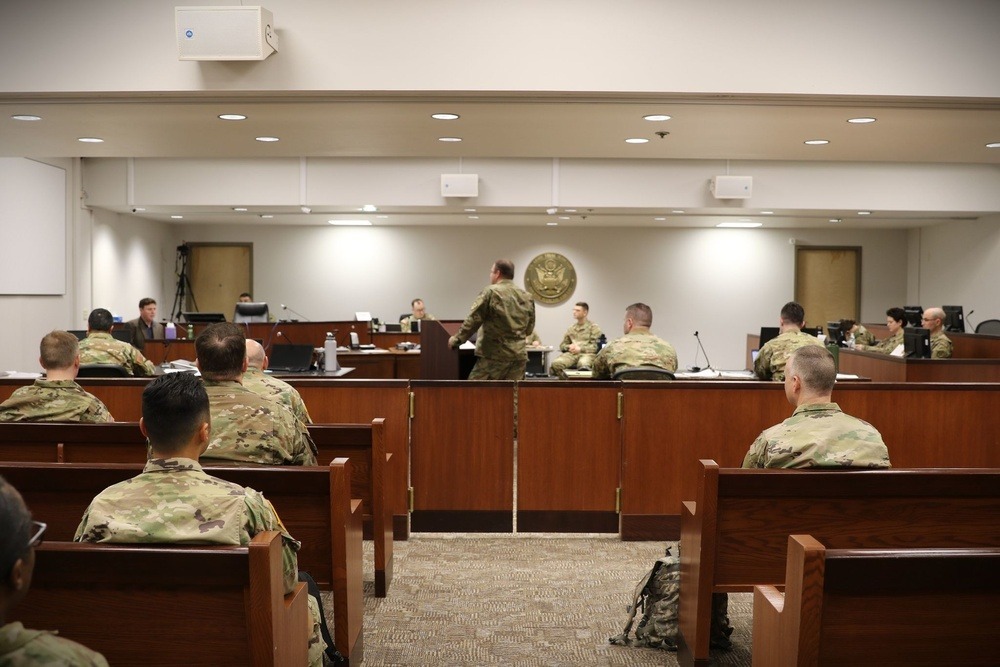
U.S. Army Reserve judge advocates conduct a mock administrative separation board at Joint Base Lewis-McChord, Wash., Feb. 4, 2023. (U.S. Army photo by Capt. Nancy Drapeza / DVIDS, public domain)