
The Coast Guard Discharge Review Board (CGDRB) case began with a local police response to a reported dispute inside Coast Guard housing. The officers wrote down what they saw: redness, bruising, and a laceration on the spouse’s neck, throat, and finger. The member spent the night in custody under a no-contact order.
Then the spouse gave the county District Attorney a different account and gave the Coast Guard a written statement disavowing victimhood of domestic assault and attributing the bruises to the previous day’s wrestling session. The no-contact order was rescinded.
A Coast Guard Incident Determination Committee (IDC) reviewed the allegation and determined that it did not satisfy the criteria for intimate partner physical maltreatment. The charges brought by the state were dismissed.
The command separated him anyway. General under honorable conditions, misconduct, commission of a serious offense, separation code JKQ, reentry code RE-4, on the theory that the police report and the statements in it established by a preponderance of the evidence an assault under Article 128, Uniform Code of Military Justice (UCMJ).

On 26 August 2026, the Coast Guard Discharge Review Board published its decision affirming it in full, four votes to none (CG DRB Docket 2020-055).
Now look at what is not on that document. There is no date of decision. No signature. No indication of when the application came in, when the board sat, when the Commandant took final action, or how long this man waited between filing and learning that his RE-4 was permanent.
The document tells you he was discharged on 10 September 2018 after two years, five months, and 13 days of service. It will not tell you what year the board that reviewed him was sitting.
That is the first thing defense counsel should take from the August 2026 release, and it is not a quibble about form. Four separate practice consequences run off that missing date, and I will get to all four. First, the release itself; then the five decisions and what they have in common; then the date problem; then a filing rule you can put in place on Monday morning.
What Did the Coast Guard Discharge Review Board Post?
Three Coast Guard Discharge Review Board Folders Moved at Once
Then three folders moved at once, all of them Coast Guard Discharge Review Board.
The 2018 folder went from 33 files to 36, the 2020 folder from 22 to 23, and the 2023 folder from 4 to 5. Every one of the five new files carries a server timestamp of 26 August 2026 at 21:04 GMT, and all three index pages report “Page last updated: Thu 27 Aug 2026 06:57:16 AM CDT” (CG DRB 2018 reading room, 2020, 2023). The dockets are 2018-031, 2018-044, 2018-051, 2020-055, and 2023-012.

Quarterly Publication Under 33 C.F.R. § 51.11 and 10 U.S.C. § 1553(f)
Five decisions in a quarter is the normal shape of movement here, not a surge. The reading room publishes its indexes quarterly for all boards by regulation, and the statute layers its own quarterly duty on top of that (33 C.F.R. § 51.11(c)(1); 10 U.S.C. § 1553(f)). The prior Coast Guard batch went up on 8 January 2026. So the rhythm holds, and the volume tells you nothing.
The composition of the release is another matter.
The board granted no relief in any of the five. Four are flat refusals on character of service, narrative reason, separation code, and reentry code. The fifth moved a single character on the decision line and refused the relief the applicant actually came for.
What Do the Five Decisions Reveal?
Read together, these five Coast Guard Discharge Review Board decisions say the same things in five different ways. Five patterns run through them, and every one of the five is something a petition can be built to answer.
Pattern 1: The Presumption of Regularity
Docket 2018-051: No Evidence Filed
First, the presumption of regularity applied in all five cases because no one rebutted it. Every decision closes on the same sentence: the applicant has not substantiated any error or inequity. The starkest example is Docket 2018-051.
A young member, one year and 19 days on active duty, drank three bottles of over-the-counter cough medicine after a breakup with his girlfriend, went into severe physical distress, and was hauled to a local hospital. He was discharged General under honorable conditions for a drug incident with an RE-4, and he petitioned for RE-3 because the RE-4 was closing police-department doors on him.
The Coast Guard Discharge Review Board listed exactly what he filed in support: a letter from the Coast Guard to a member of Congress about his case, his own earlier statement about the events, a post-service certificate, a resume, his email traffic with the board, and his DD-214.
Then it said the thing that should be printed above every discharge-review practitioner’s desk: “None of these documents speak to the equity or inequity of his discharge under 33 C.F.R. 51.7 or 51.8” (CG DRB Docket 2018-051).
He lost 4-1 on a submission that contained no evidence directed at the standard.
Defense Takeaway: Cite § 51.7 and § 51.8
That is not the board being hostile. That is the board reading a filing aimed at sympathy and responding with a citation.
Sections 51.7 and 51.8 are short; they are public, and they list the factors by name:
- Quality of service
- Capability to serve
- Arbitrary, capricious or discriminatory action by people in authority
- Any other relevant and material information
Build the petition as an element-by-element response to that list, with an exhibit under each element, and you have at least made the board work.
Pattern 2: The Board Reviews the Command’s Process
Docket 2020-055: Charges Dismissed, Discharge Upheld
Second, this Coast Guard Discharge Review Board tested the command’s evidence, not the truth of the allegation. Docket 2020-055 sets the frame in one sentence: “the Board reviews the Command’s process of discharge to determine its conformity with CG policy and concurs the discharge was both proper and equitable.” Then it shows what that frame does. The board “discussed the evidence surrounding the alleged assault within the context of this specific case and determined the Command had a preponderance of evidence to bring forth the separation.”
It weighed the evidence and asked only whether the command had enough of it. Which is why the recantation, the IDC finding, and the dismissal of the state charges all landed on the floor.
Docket 2018-044: Statute of Limitations
Docket 2018-044 makes the same point through a statute-of-limitations fight.
That applicant had 13 years, seven months, and five days of active duty, self-reported marijuana and cocaine use to his commanding officer, and left with an Other Than Honorable discharge. His counsel argued that the drug specification exceeded the two-year limitation under Article 15, UCMJ.
The Coast Guard Discharge Review Board answered on the merits, found the punishment fell nine months after the admitted use, and then closed the door a second time: a discharge under COMDTINST M1000.4 Article 1.B.17 “is not bound by the statute of limitations, making the Applicant’s claim irrelevant” (CG DRB Docket 2018-044).
Defense Takeaway: An Involuntary Separation Is Not a Prosecution
Take the lesson narrowly, because it is narrow. Punitive-law defects are worth raising when they infected the administrative decision, and worth abandoning when they did not. An involuntary separation for misconduct is not a prosecution, and a petition that devotes its best pages to relitigating the offense has done so in the wrong forum.
Pattern 3: Waiver Documents Beat Testimony
Docket 2018-044: Six Claims Raised
Third, the paper record of a waiver will beat the story of the pressure behind it. Docket 2018-044 raised six claims, and the two strongest were human ones. He said he was never told what an Other Than Honorable discharge would cost him.
He said he was told an administrative separation (ADSEP) board could take up to a year, that he felt he would be ostracized by his shipmates while he waited, and that his father was ill and needed him in the family business – so he waived the board.
Anyone who has sat across a table from a member in that position knows the pressure is real.
The Coast Guard Discharge Review Board’s Answer: Initials and Article 1.B.23
The board answered it with initials. There was a memo in the separation package describing the possibility and consequences of an Other Than Honorable discharge, and he had initialed to acknowledge that he had received and reviewed it. He was encouraged in the same memo to consult a lawyer.
On two separate occasions he initialed a waiver of counsel, and on two separate occasions he waived the board. Counsel argued that a member facing an Other Than Honorable discharge must consult a lawyer, and the board turned to the text: Article 1.B.23.a provides that the member shall be afforded the right to counsel, and there is no language in 1.B.23 stating that the right cannot be waived.
Defense Takeaway: Three Documents That Prove Involuntariness
That is a correct reading, and it is why an involuntariness theory has to be built from contemporaneous material rather than from testimony offered years later. Get the counseling-form time stamps. Get the notification memo and read what the command actually represented about the board timeline in writing.
Get the defense counsel’s file. If the only evidence of coercion is the client describing it to the board, you will lose to a set of initials.
Pattern 4: Zero Tolerance in Both Drug Cases
Docket 2018-044 and Docket 2018-051: Equity, Not Propriety
Fourth, “zero tolerance” carried both drug cases, and both dissents show exactly where the seam is. Neither of the drug decisions was unanimous. Docket 2018-044 went 3-2. Docket 2018-051 went 4-1. Both dissents rest on equity, not propriety, and the two dissenting members in 2018-044 wrote something a practitioner should read twice.
3-2
Docket 2018-044
4-1
Docket 2018-051
They said the Other Than Honorable characterization was disproportionately severe and inconsistent with policy because discharges for misconduct involving illegal drugs under COMDTINST M1000.4 typically result in a General under honorable conditions characterization. They said his waiver of the ADSEP board – a choice made in comparable cases to obtain a better characterization – had instead produced the lowest available designation for the offense.
And they said a member who self-reports ought to end up no worse than a member caught by a random urinalysis.
§ 51.7(a)(3): Comparative Disposition
That is a § 51.7(a)(3) argument, and it drew two of five votes. Section 51.7(a)(3) asks whether the military record and the evidence presented, viewed against the factors in § 51.8 and the regulation the member was discharged under, “do not fairly justify the type of discharge received.”
Defense Takeaway: Plead the Delta as a Number
Comparative disposition is the way into that provision. Plead the ordinary outcome the policy produces, plead the specific characterization your client would have received on the identical facts through a different door, and put the delta in front of the board as a number rather than as an appeal to fairness.
In 2018-044, that argument came one vote short of relief in a case the board otherwise treated as routine.
Pattern 5: Single-Cause Theories Fail
Docket 2023-012: Five Negative CG-3307s
Fifth, a single-cause theory collapses against a multi-document record. Docket 2023-012 is the cleanest illustration in the release. The applicant received an Honorable discharge for completion of service with an RE-4 and petitioned to reenlist in the Reserves and finish his career.
His theory was that the RE-4 stemmed from his refusal of the COVID-19 vaccine after a religious accommodation request, and that, with the mandate lifted, the code should be removed.
The record held five negative CG-3307 administrative counselings. One was the vaccine. The others were an attempt to threaten or extort another crew member, a failure to follow procedures on an RBS-II that put the asset in a ready status with a potential disabling casualty, a failure to obey orders during a search-and-rescue mission for a person in the water, and a maturity and judgment problem during an Officer of the Day qualification.
His Boarding Officer and Coxswain qualifications had both been rescinded for loss of confidence. The board found the performance documentation ran four years ahead of the vaccine mandate and called the single-cause claim erroneous — a finding the record made unavoidable (CG DRB Docket 2023-012).
Docket 2018-031: Separation Code JGA
Docket 2018-031 fails the same way from the other end of a career. 13 days into training at Training Center Cape May, a prior-enlisted reservist with six years of Air Force service was separated for refusal to train, uncharacterized, JGA, RE-3L. He asked the board to convert the code to a medical release for a hip injury so he could rejoin the Air Force.
The record contained his own documents reflecting a desire to end training, an acknowledgment that he understood his options and their consequences, and a record of his decline of the recruit evaluation board he was offered (CG DRB Docket 2018-031).
Defense Takeaway: Review the Full Record First
The practice point is unglamorous, and the one most often skipped. Pull every adverse document in the field-service record and the electronic personnel record before you pick a theory, not after. If your client’s account is the one thing that caused the outcome, and the record shows five, the board will find the other four, and your credibility goes with them.
What Did the Board Actually Correct?
One character moved in this entire release. In Docket 2018-051, the Coast Guard Discharge Review Board refused the reentry-code relief the applicant requested, then, on its own motion, recommended an administrative correction to Block 26 of the DD-214, changing the separation program designator from JKK to JKM, as the code that the Personnel Service Center guidance actually prescribes for a drug incident.
The January 2026 batch shows the same instinct at work in Docket 2020-013, where the board left character, narrative reason, and codes untouched but entered a new separation authority on the decision line, moving Article 1.B.11 to Article 1.B.17 (CG DRB Docket 2020-013).
So this board has twice fixed a coding error that nobody asked it to fix. Which makes a coding audit the cheapest item on any petition. Run Block 26 and Block 27 of the DD-214 against the Separation Program Designator Handbook and the current Personnel Service Center guidance in every single case, name the mismatch, and ask for the correction expressly. It is the only relief this reading room shows the board granting on its own initiative, it costs the client nothing, and a corrected code occasionally carries a different prescribed reentry code with it.
Say the rest of it plainly, though. Four applicants asked for something and got nothing, and the fifth got a two-letter fix he never requested, while losing the RE-4 that was costing him police department employment. Nobody should walk a client into this forum describing it as favorable.
Why Does the Missing Decision Date Matter?
The Objection: 33 C.F.R. § 51.10(b) Does Not Require a Decision Date
Here is the objection to what I said at the top, and it is a fair one. The regulation does not require a decision date. Section 51.10(b) lists eight things a decision document must contain, and the first is “the date, character of, and reason for the discharge including the specific authority under which the discharge was issued.”
That is the date of the separation, and all five decisions carry it. The reading-room index requirement in § 51.11(c)(1) reaches the case number and “the date, character of, reason for, and authority for the discharge,” which is the same date again. The date column on
the index page is the posting date, not the decision date.
On the face of the rules, this Coast Guard Discharge Review Board is compliant.
Reconsideration: Two of Three Grounds Require a Date
Concede all of that. It does not reach the problem, because § 51.11(c) also says the public copy goes up “promptly after a notice of the final decision is sent to the applicant.” A docket numbered 2018 surfacing in August 2026 leaves eight years unaccounted for on the face of the document, and the numbering is not keyed to separation: Docket 2020-055 concerns a discharge issued on 10 September 2018.
Either the board sat on the application for years, or the publication was not prompt. The document does not permit the public to tell which, and — this is the part that reaches a client — it does not permit counsel to tell either.
The older postings are no better and in some respects worse – Docket 2018-001, posted in the August 2025 batch, carries no decision date and no date of separation at all, and disposes of a General discharge for misconduct in four sentences (CG DRB Docket 2018-001).
Four Consequences of an Undated Discharge Review Board Decision
Four consequences, and none of them is academic.
Reconsideration Under 33 C.F.R. § 51.9(h)
Section 51.9(h) permits reconsideration on three grounds only: the sole prior consideration was on the board’s own motion, changes in discharge policy occur, or new, substantial, relevant evidence not available at the time of the original review is submitted. Two of those three are temporal.
To argue that discharge policy changed, you have to fix the date the board decided. To argue that evidence was unavailable at the time of the review, you have to fix the date of the review. The document withholds both.
The Correction-Board Follow-On Under 10 U.S.C. § 1552
Section 1553(b)(2) of Title 10 provides that when the review board declines an upgrade, the declination may be considered under § 1552 by the correction board. Every § 1552 filing runs against a limitation measured from discovery of the error, and the declination is the event.
A client who cannot date his own denial is guessing at the trigger.
Comparative Disposition Without a Term, Panel, or Year
The fourth commonality above lives or dies on the ability to say that a materially identical case came out differently. You cannot make that argument by term, by panel, or by year, because no decision in this reading room carries a term, a panel, or a year.
The Sample: An Incomplete Reading Room
The sample. The reading room is not a complete set, and the numbering makes that obvious on inspection. The 2018 folder holds 36 files across docket numbers running to 2018-056, with roughly 20 numbers absent. So never tell a board, or a client, that the CGDRB “always” or “never” does something based on this collection.
The statutory quarterly reports under § 1553(f) are the place to look for denominators – request counts, mental-health-related claims, upgrades granted, and the disposition of claims involving alleged sexual assault. Argue from the reported numbers, and treat the reading room as an anecdote.
What Else Do the Five Documents Leave Out?
None of the five mentions the Coast Guard Discharge Review Board’s composition. None mentions liberal consideration.
Liberal Consideration Under 10 U.S.C. § 1553(d) and § 1553(e)
That matters more than the missing dates in at least two of these cases. Section 1553(d)(1)(B) reaches a former member claiming that post-traumatic stress disorder or traumatic brain injury is based in whole or in part on sexual trauma, intimate partner violence, or spousal abuse, and requires the board to seek advice and counsel from a psychiatrist, psychologist, or social worker with training in those conditions.
Section 1553(d)(3)(A)(ii) requires the board to review the case “with liberal consideration to the former member” that the condition potentially contributed to the circumstances of the discharge or to its characterization. Section 1553(e) requires a clinical psychologist, psychiatrist, or a physician with special training in mental health disorders to sit on the board where the member was diagnosed with a mental health disorder while serving.
Docket 2020-055 and Docket 2018-051 Measured Against the Statute
Set that against Docket 2020-055, a discharge arising out of a domestic altercation between spouses. Nothing in the decision says whether the applicant raised a qualifying condition, and nothing says whether the board asked.
Set it against Docket 2018-051, where a member ingested three bottles of cough medicine after a breakup and was hospitalized, and where the majority weighed against him the “deliberate premeditation in obtaining multiple bottles of cough medicine from different sources to avoid detection,” and expressly noted he had clarified that his actions were not driven by suicidal intent. On that record the statute may not have been engaged at all, because § 1553(d) reaches post-traumatic stress disorder and traumatic brain injury tied to combat or military sexual trauma, and none of that appears. What appears instead is a board reading premeditation into a hospitalization.
I am a medically retired officer rated 100% combat-related disabled, and I will say this without hedging it: the paragraph in 2018-051 reads like a document written by people who never had a clinician in the room. Whether one was there is unknowable from the face of the decision, because the decision does not say.
The Pleading Remedy Available Today
The remedy is a pleading remedy, and it is available today. Invoke § 1553(d) and § 1553(e) expressly in the application, state the diagnosis and the date of it, attach the Department of Veterans Affairs or civilian medical evidence the statute obligates the board to review, and demand that the board state on the record who sat and what expertise they held.
Two Fixes: Four Lines for the Board, Two Filings for Counsel
For the Coast Guard Discharge Review Board
For the Coast Guard Discharge Review Board, the fix is four lines of text, and it costs nothing. The material already sits in the record of proceedings that § 51.11(a) requires the board to keep.
Print, on the face of every published decision, four things the current documents omit: the date the application was received, the date the board sat, the date of the final action by the Commandant or the Secretary, and the composition of the panel with the expertise of each member where § 1553(d) or § 1553(e) is in play.
Four lines. That is the whole ask.
The Four Lines the Board Should Print
- The date the application was received
- The date the board sat
- The date of the final action by the Commandant or the Secretary
- The composition of the panel, with each member’s expertise where § 1553(d) or § 1553(e) is in play
For Counsel
For counsel, a rule you can adopt this week. On the day you file the DD Form 293, file two things with it. A written request under § 51.9(c) and § 51.9(e) for notice of the review date and for the documents the board will consider, which the regulation already entitles you to.
And a Privacy Act and Freedom of Information Act request for the complete record of proceedings under § 51.11(a), including the summarized record of testimony, the advisory opinions relied on, and the final action. Then calendar the FOIA follow-up for 30 days out.
Filing Rule: Three Items to Send With the DD Form 293
- A written request under § 51.9(c) and § 51.9(e) for notice of the review date and for the documents the board will consider
- A Privacy Act and Freedom of Information Act request for the complete record of proceedings under § 51.11(a)
- A calendar entry for the FOIA follow-up, 30 days out
FAQs
Can the Coast Guard Discharge Review Board Change an RE-4 Code?
Yes. The board may change an RE-4 when the applicant proves that the code was improper or inequitable. A coding correction may also require a different prescribed reentry code. That does not guarantee reenlistment; the gaining service still controls accession.
What Evidence Should Accompany a DD Form 293?
Attach evidence aimed at the governing standard, not a stack of character letters aimed at sympathy. That usually means the complete separation package, the DD-214, relevant personnel and medical records, contemporaneous evidence rebutting the command’s stated basis, proof of comparable dispositions, and a short exhibit tied to each claimed error or inequity.
What Is the Difference Between Correcting a Separation Code and Upgrading Character of Service?
A separation-code correction changes the administrative basis recorded in Block 26 of the DD-214. A character-of-service upgrade changes the legal quality of the discharge, such as General under honorable conditions to Honorable. One does not automatically produce the other. Ask for each form of relief separately and prove each one.
Will a Corrected Separation Code Result in a DD Form 215?
Not necessarily. A board decision may direct or recommend correction, but the records custodian determines how the corrected entry is issued. The result may be a DD Form 215 or a corrected or reissued DD-214 under the procedures then in force. The board’s decision itself is not the correction document.
How Long Does a Coast Guard Discharge Review Board Petition Take?
There is no reliable processing time in the five published decisions because they omit the filing, review, and final-action dates. A docket number is not proof of how long the petition was pending. Request notice of the review date when filing, preserve every receipt, and follow up in writing rather than building a deadline around an estimate.
Who Represents Servicemembers in Coast Guard Discharge-Review Proceedings?
A former member may retain a civilian military lawyer or seek representation from a qualified veterans-service organization or other authorized representative. The useful question is not who will sign the DD Form 293. It is who will obtain the complete record, identify the governing standard, and connect each requested correction to admissible proof.
This post is written for general educational purposes and is not legal advice to any person or matter.
Sources:
Every fact in this post comes from the decision documents in Coast Guard Discharge Review Board Dockets 2018-031, 2018-044, 2018-051, 2020-055 and 2023-012, all posted on 26 August 2026; from Dockets 2020-013 and 2018-001, posted in the 8 January 2026 and 15 August 2025 batches. Regulatory and statutory text is quoted from 33 C.F.R. Part 51 and 10 U.S.C. § 1553. Coast Guard policy is cited as it appears in the decisions themselves, at COMDTINST M1000.4 Articles 1.B.11, 1.B.17 and 1.B.23. All documents are available through the Armed Forces Discharge Review/Correction Board Reading Room.
Photo Source:
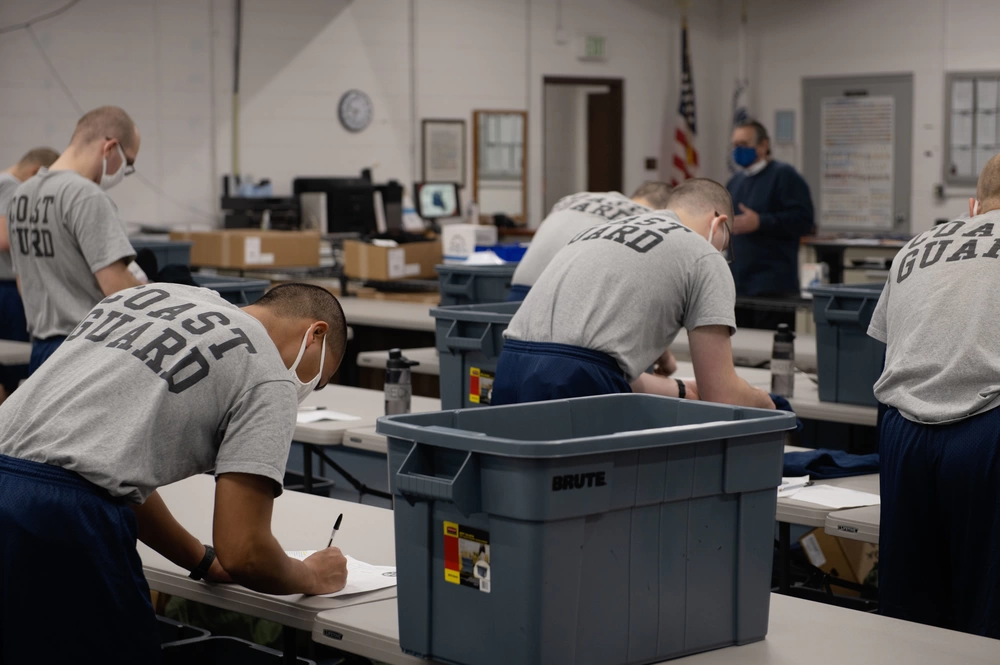
U.S. Coast Guard recruits from recruit company T-199 sign paperwork at the uniform distribution center at U.S. Coast Guard Training Center Cape May, New Jersey, on 5 January 2021. (U.S. Coast Guard photo by Petty Officer 2nd Class Shannon Kearney / DVIDS, public domain)