
The FY2025 military sexual assault report contains a figure almost nobody quotes: 32 of the 130 penetrative sexual assault cases that reached trial ended in acquittal. That is one in four.
This is not a victory lap. A trial is a brutal way to learn that the evidence did not carry the burden – for the person accused, for the person who reported the assault, for the witnesses, and for the unit that has waited more than a year for an answer.
It is a number that should make every lawyer in the system more careful, not more pleased with himself.
The Department of War published it in Appendix C, Non-Metric 2, and I have not seen it quoted in the public argument about military sexual assault. The usual statistic is 161 convictions from 201 trials, or 80%. That is a true count. It is not the whole story.
This is Part 5 of a 12-post reading of the FY2025 sexual assault report appendices. The point is narrow: a sexual assault court-martial conviction rate quoted without the acquittals, the dismissals, the cases resolved in lieu of trial, and the charge-by-charge split asks the readers to trust a conclusion it has not shown them.
Court-Martial Outcomes in the FY2025 Report
Where Figure 12 Does Not Add Up
Figure 12 of the military sexual assault report begins with 340 cases in which sexual assault court-martial charges were preferred. It reports 291 completed cases and 43 cases not completed in FY2025.
Those two numbers add to 334, not 340. The Figure does not explain the six-case gap in its displayed flow.
That arithmetic matters because reports are meant to let readers follow the case flow without guessing. I can report the 291 completed cases because the Figure reports them. I cannot tell you where the other six went, and neither can the Figure.
How the 291 Completed Court-Martial Cases Ended
Of the 291 completed cases, 201 proceeded to trial, 51 resulted in resignation or discharge in lieu of court-martial, and 39 resulted in dismissal of the sexual assault court-martial charges.
| Outcome | Cases | Share |
|---|---|---|
| Proceeded to trial | 201 | 69% |
| Resignation or discharge in lieu of court-martial | 51 | 18% |
| Court-martial charges dismissed | 39 | 13% |
Of the 201 that went to trial, 161 resulted in a conviction on at least one charge, and 40 resulted in an acquittal on all charges, or 20% of the 201 trials.
161
Conviction of Any Charge
40
Acquitted of All Charges
40 people tried on the government’s charges were acquitted across the board.
What the Acquittals Do and Do Not Prove
A fair reader should resist two bad conclusions.
The 40 military sexual assault acquittals do not prove 40 false allegations. An acquittal says the government did not prove its case beyond a reasonable doubt. It does not tell the public why the proof fell short, and it does not license anybody to turn a victim’s report into a slur.
Nor does an 80% conviction rate prove that every charging decision was right. Both claims ask a criminal verdict to answer a factual question it was not designed to answer.
Not Every Sexual Assault Court-Martial Is the Same Case
Why Survey Categories Do Not Match Charges
The report’s prevalence annex uses labels that should not be laid over these charging categories. Its penetrative, attempted-penetrative, and non-penetrative estimates are mutually exclusive and assigned in that order, so a member who indicated more than one behavior is counted once in the most serious category.
Charges do not work that way, and neither does an acquittal. A single sexual assault court-martial can contain several specifications, pleadings can change the case, and the trial result is counted by the charges actually tried rather than by a survey hierarchy.
Penetrative Cases: One in Four Acquitted
Appendix C of the military sexual assault report does what Figure 12 does not: it divides the completed sexual assault court-martial results by the crime charged.
Of 185 completed penetrative cases, 25 were dismissed, 30 ended in a resignation or discharge in lieu of court-martial, and 130 proceeded to trial. Of those 130 trials, 32 ended in acquittal and 98 ended in conviction of any charge.
That is the one-in-four figure: 25% of penetrative cases tried ended in full acquittal.
Sexual-Contact Cases: A Different Shape
The military sexual assault acquittals in FY2025 were not spread evenly across charge types, and the sexual-contact cases ran differently.
Of 101 completed sexual-contact cases, 14 were dismissed, 21 resulted in resignation or discharge in lieu of court-martial, and 66 proceeded to trial.
Seven of those 66 trials, or 11%, ended in acquittal, while 59 ended in conviction of any charge.
| Outcome | Penetrative cases | Sexual-contact cases |
|---|---|---|
| Completed cases | 185 | 101 |
| Charges dismissed | 25 | 14 |
| Resignation or discharge in lieu of court-martial | 30 | 21 |
| Proceeded to trial | 130 | 66 |
| Convicted of any charge | 98 | 59 |
| Acquitted of all charges | 32 | 7 |
| Acquittal rate at trial | 25% | 11% |
Why the Charge Changes the Conviction Rate
The difference is sharp enough that no lawyer reading the military sexual assault report should talk about “the conviction rate” as if the charge did not matter.
Penetrative cases and sexual-contact cases carry different evidence, different accounts of capacity and consent, different corroboration questions, different charging choices, and sometimes very different sentencing exposure; the Department’s own table makes the split plain.
From June 2010 through August 2014, I prosecuted special-victim cases in Germany and Italy, as well as in Iraq, Afghanistan, and Kuwait. I know the work it takes to bring a case to trial, and I know why a prosecutor believes a case can be proven even when a panel later disagrees. A full acquittal is not proof that the prosecutor acted in bad faith. It is proof that the legal system asked a hard question and received an answer the government must accept.
That is the price of a real burden of proof, and it is also its purpose.
Discharge in Lieu of Court-Martial and the 39 Dismissals
The courtroom results are only one branch of the flow in the military sexual assault report. Of the 291 completed cases, 51 ended in resignation or discharge in lieu of court-martial, which the report calls RILO/DILO cases.
The choice belongs to the accused, who asks to leave the service rather than go to trial, and it comes after charges have been preferred.
What Discharge in Lieu of Court-Martial Actually Costs
That choice is not a neutral administrative shortcut. Appendix B of the military sexual assault report explains that a request for discharge in lieu of court-martial must include three things:
- an acknowledgment of the charged offense and its consequences
- an acknowledgment that separation may carry a negative characterization
- an acknowledgment of guilt to an offense authorizing a punitive discharge, or a summary of the evidence supporting guilt
The process needs case-specific advice because it trades trial risk for a record consequence.
What an Other Than Honorable Discharge Costs
Of those 51 cases, 48 enlisted members who took a discharge in lieu in FY2025 received an Under Other Than Honorable Conditions characterization.
That is not a footnote; it can limit access to Department of War and Department of Veterans Affairs benefits and becomes part of the DD Form 214 that the veteran must carry to the next job, the next apartment application, and the next explanation of that service.
Why 39 Sexual Assault Court-Martial Cases Were Dismissed
Then there are the 39 dismissals. A dismissal can mean a charge failed at an Article 32 preliminary hearing, a prosecutor re-evaluated the evidence, a witness problem became unrecoverable, a legal issue changed the case, or some other fact the public table does not supply; we do not know the reason for each dismissal, and the report does not pretend that we do.
We do know something else from Appendix B. In seven of the 39 dismissed court-martial cases, the evidence supported nonjudicial punishment for other misconduct discovered in the sexual assault investigation, and four of those subjects were later discharged.
39
Charges Dismissed
7
Turned into Other Misconduct
4
Discharged
A sexual assault charge being dismissed does not always mean a client’s interaction with the system is over. Sometimes it means the case changes its name and continues on paper.
What a Sexual Assault Court-Martial Conviction Means
The 161 convictions in Figure 12 are for “any charge,” as the military sexual assault report states explicitly. A conviction in that count could be for a sexual assault offense, or for other misconduct charged at the same sexual assault court-martial.
Why the 80% Conviction Rate Needs an Asterisk
That caveat is not a lawyer’s quibble. In the same FY2025 table, 899 of 2,220 cases in which the Department found evidence to support action involved only non-sexual-assault misconduct discovered during a sexual assault investigation.
False official statements, adultery, underage drinking, and other offenses can become the case when the sexual assault allegation does not.
So, when a headline says 80% of tried cases produced a conviction, the accurate reply is not that the number is false. It is that the number does not tell us how many convicted service members were convicted of a sexual assault offense, as opposed to some other charge.
Those results are not interchangeable. A verdict on a false official statement is not a verdict on rape.
Three Extra Lines Would Fix the Report
The Department could fix this without changing a single case outcome. It could publish three extra lines:
- convictions of a sexual assault offense
- convictions only of other charged misconduct
- acquittals of all charges
Until it does, a reader should not supply the missing category with assumptions.
I would make the same demand of the defense bar. Do not use the 40 acquittals to suggest that all charges are suspect. Put the actual case in front of the fact-finder: the exact charge, the evidence, the admissions, the contradictions, the missing material, and the consequences.
A number describes the system. It does not acquit a person.
Court-Martial Sentencing and the 408-Day Wait
The sentences are another reason to demand precision from the military sexual assault report.
What Court-Martial Punishment a Conviction Brought
Among the 161 cases that resulted in conviction of any charge, 128 brought confinement, 119 brought a punitive discharge or dismissal, 88 brought reduction in grade, 49 brought a fine or forfeiture, and 23 brought a reprimand.
| Punishment adjudged | Cases | Share |
|---|---|---|
| Confinement | 128 | 80% |
| Punitive discharge or dismissal | 119 | 74% |
| Reduction in grade | 88 | 55% |
| Fine or forfeiture | 49 | 30% |
| Reprimand | 23 | 14% |
Subjects can receive more than one punishment, so the categories do not add up to 161.
The report also states that 72 subjects convicted of a sexual assault offense were notified they may have to register as sex offenders. Another 20 convicted subjects who did not receive a punitive discharge at trial were subsequently processed for administrative separation.
That is not a system in which trial consequences evaporate merely because a panel does not adjudge every available punishment.
A conviction can lead to confinement, discharge, registration, a later separation action, or several of these at once. The case needs to be prepared for the whole record, not just the findings.
Why a Court-Martial Takes 408 Days
The time figure explains part of the pressure. Appendix C reports an average of 408 days from the report of sexual assault to court-martial result, with a median of 389 days. The report puts the average time to a nonjudicial punishment result at 200 days and the median at 183 days.
| Route | Average days | Median days |
|---|---|---|
| Court-martial result | 408 | 389 |
| Nonjudicial punishment result | 200 | 183 |
That comparison is not exact, because different cases take different paths. A wait of 408 days is still long enough for witnesses to move, memories to settle into stories, phones to be replaced, security clearances to wobble, evaluations to come due, and a family to live in legal purgatory.
The answer is not to cut corners in investigation or deny a reporting service member support. The answer is to preserve evidence early, disclose it on time, litigate real issues on a schedule, and refuse to let delay become a bargaining chip against either side.
A court-martial is supposed to test evidence, and it cannot perform that job when delay turns the test into a negotiation over exhaustion.
What the Military Sexual Assault Report Gets Right
Where the Department Deserves Credit
The strongest objection is plain. The Department publishes more criminal-case data than a civilian prosecutor’s office would ever volunteer, including the acquittals, dismissals, and timelines this post uses. It does not hide the 40 acquittals; it puts them in an appendix available to anyone who will read it, and 161 convictions of any charge from 201 trials is still a serious result.
I concede every part of that. The Department deserves credit for publishing both the unfavorable and favorable figures, and no one should manipulate the data to claim the military justice system never holds offenders accountable.
Where Publication Stops Short of Explanation
My disagreement is with the way a partial figure is used to support a final argument.
The public can see the 80% number and still not know the sexual-assault conviction count, the reason for the 39 dismissals, the route taken by six preferred cases that Figure 12 does not reconcile, or why penetrative trials end in full acquittal more than twice as often as sexual-contact trials.
Publication is not the same thing as explanation. A table can disclose a number without telling the reader what it means.
The institutional consequence is modest but real. When the government uses a conviction-rate statistic to shape policy, training, command climate, or a board packet, it owes the audience the result it actually measured. “Convicted of any charge” is a proper category; it is not a synonym for convicted of sexual assault.
How to Use the Military Sexual Assault Report in a Real Case
When a lawyer, a commander, or a client cites an 80% court-martial conviction rate, ask three questions before accepting the premise:
- What crime was charged?
- Was the conviction for a sexual assault offense or some other misconduct?
- What happened to the cases that did not reach trial?
Then demand the records that answer those questions in the individual case: the charge sheet, the Article 32 report if there was one, discovery indexes, plea papers, motions and rulings, the findings worksheet, the sentencing record, and the post-trial separation documents. Do not let Figure 12 do the work of the case file.
That is the usable rule: count the acquittals, name the charge, and do not call a conviction what the record does not show it was.
What Comes Next in This Series
Part 6 compares the tables for the Army, Navy, Marine Corps, and Air Force. The same statute and the same Manual for Courts-Martial produce very different action rates once the reader puts the four service columns beside one another.
FAQs
Should I Accept a Discharge in Lieu of a Sexual Assault Court-Martial?
Maybe, but not before counsel compares the evidence and trial exposure against the permanent cost of leaving the service. A resignation or discharge in lieu of court-martial may require an acknowledgment of guilt or a summary of the evidence, and an enlisted member may receive an Under Other Than Honorable Conditions characterization. That can affect benefits, employment, and the DD Form 214. This is a case-file decision, not a statistical one.
How Can a Military Defense Lawyer Challenge a Sexual Assault Charge?
A military defense lawyer can test whether the government can prove every element beyond a reasonable doubt, preserve phone and location evidence, examine prior statements for material conflicts, challenge inadmissible evidence, litigate expert and discovery issues, and expose investigative assumptions. The defense must be built around the charged specifications and the actual file. Acquittal statistics do not try the case.
Who Represents Service Members in Sexual Assault Courts-Martial Worldwide?
Civilian military defense counsel may represent service members worldwide, alongside or in place of detailed military counsel. The Law Office of Will M. Helixon provides courts-martial defense to members of the Army, Air Force, Navy, and Marine Corps facing sexual assault courts-martial, including cases arising overseas.
Does an Acquittal Mean the Sexual Assault Report Was False?
No. An acquittal means the government did not prove every required element beyond a reasonable doubt. It does not establish why the proof failed, and it does not convert the report into a false allegation.
Does "Convicted of Any Charge" Mean Convicted of Sexual Assault?
No. The category may include a conviction for another offense charged at the same court-martial. Unless the report separates sexual assault convictions from convictions only for other misconduct, those results cannot fairly be treated as the same thing.
What Happens After Sexual Assault Charges Are Dismissed?
The case may end, but dismissal does not guarantee that every consequence disappears. Other alleged misconduct may lead to nonjudicial punishment, administrative separation, or another personnel action. Counsel should confirm in writing what remains open.
This post is written for general educational purposes and is not legal advice to any person or matter.
Sources:
All figures in this post come from Appendix B, Figure 12 and the court-martial discussion, and Appendix B, Table 4; and Appendix C, Non-Metric 2 and Figure S, and Non-Metrics 3 and 4 with Figures T and U. The report as posted by the Sexual Assault Prevention and Response Office is at the SAPRO reports page
Photo Source:
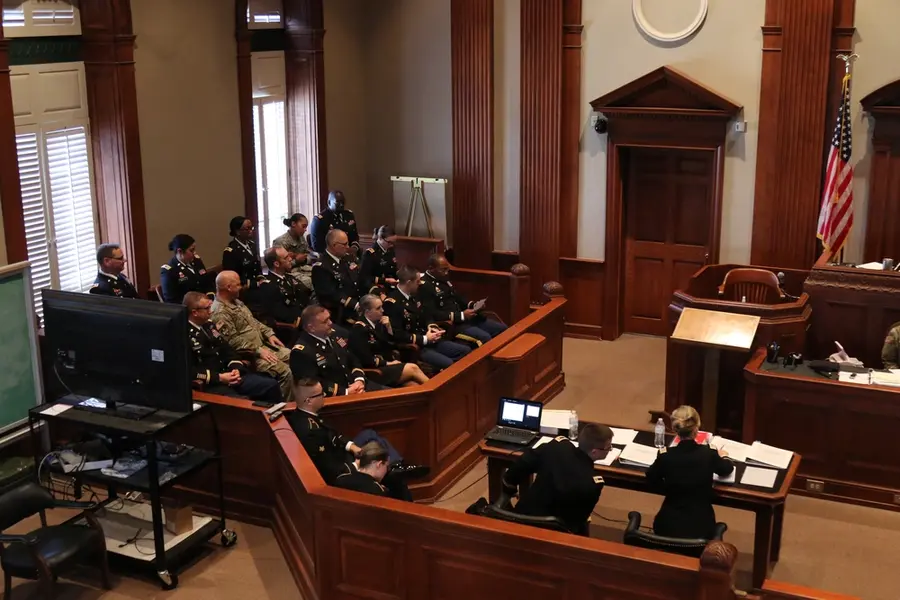
Members of a court-martial panel listen to instructions during the 167th Theater Sustainment Command's fourth annual mock court-martial at the Calhoun County Courthouse, Anniston, Ala., Aug. 7, 2018. (Army National Guard photo by Sgt. Jeremy Dunkle / DVIDS, public domain)