
The Military Rule of Evidence (M.R.E.) 404(b) fight in United States v. Menard, No. 25-0173/AF, 2026 CAAF LEXIS 815 (C.A.A.F. 28 Sept. 2026), began with a text while she was alone in the bedroom: “Did you make any videos today?” Then, “Any videos? Bring the toy out?” Later, after she tried on outfits and took photographs to send a friend, came a message about her “blue outfit.”
She searched the room, found a camera hidden with a line of sight to the bed, and pulled the plug. The moment she did, he texted again: “Oh look you caught on. Bravo” (slip op. at 3-4).
That is the case the Government took to an officer panel against Senior Airman Jerin P. Menard, and it was a strong case. It was not strong enough for the prosecutors, who also put three pieces of the couple’s earlier history before the members – that he demanded her social media passwords, read her phone while she slept, and blocked her male friends and former boyfriends on her accounts – under the M.R.E. 404(b) label “common plan or scheme.”
On 28 September 2026, the Court of Appeals for the Armed Forces (CAAF) held that the military judge was wrong to admit that history, wrote one sentence every defense counsel should put in the next motion in limine, and then affirmed the conviction and bad-conduct discharge anyway.
Three to two on error. Five to nothing on the result. Both halves of that vote matter. This post examines what the Court held, why the Government lost the argument and won the case, the two arguments the next trial counsel will make to get around Menard, and four things to do at the motion hearing.
Why M.R.E. 404(b) Matters in a Relationship Case
How Relationship History Becomes Propensity Evidence
In an intimate-partner case, the relationship history is often the most dangerous evidence in the room. The charged act is one night, and the history is months or years of jealousy, demands, and arguments, told by the person the members are already inclined to believe. Once the members hear it, the charged act stops looking like an event that has to be proven and starts looking like the kind of thing this man does. That inference has a name, propensity, and M.R.E. 404(b)(1) forbids it.
What Other-Act Evidence Does M.R.E. 404(b)(2) Allow?
The escape hatch is M.R.E. 404(b)(2), which says other-act evidence “may be admissible for another purpose, such as proving motive, opportunity, intent, preparation, plan, knowledge, identity, absence of mistake, or lack of accident” (M.R.E. 404(b)(2), Manual for Courts-Martial, United States, at III-19 (2024 ed.)).
The Court of Military Appeals put the governing principle in one line almost 40 years ago: “evidence which is offered simply to prove that an accused is a bad person is not admissible” (United States v. Reynolds, 29 M.J. 105, 109 (C.M.A. 1989)). Everything in Menard turns on whether “plan” is a real purpose or a costume.
A Former Special Victim Prosecutor on Relationship Evidence
I spent June 2010 to August 2014 as a Special Victim Prosecutor, trying cases principally in Germany and Italy. I understand the pull of the relationship evidence from the other table.
It makes the story make sense, it makes the victim’s fear make sense, and it makes the members comfortable convicting. None of that makes it admissible. A prosecutor who reaches for “plan” because the story feels incomplete without the history is reaching for character evidence and calling it something else.
What Happened at Trial in United States v. Menard
The Case
The Charge
The charge was a single specification of indecent viewing under Article 120c, Uniform Code of Military Justice (UCMJ). He admitted to the Air Force Office of Special Investigations (OSI) that he placed the camera and checked the live feed three separate times, but he denied seeing RH nude. The Defense theory was narrow and technical: the camera broadcast and did not record, so nobody could prove what he actually saw (slip op. at 4).
What Was Admitted and Why
The Government noticed six uncharged acts under M.R.E. 404(b) as proof of “intent, knowledge, and a common scheme to control RH.” The military judge kept out three and admitted three:
- the passwords
- the phone
- the blocking
His written ruling found a stack of purposes, including that the Accused “had an intent and motive to dominate and control RH” and a plan to monitor her, and it added that excluding the evidence “would deprive the members of critical context” (slip op. at 4-5, 11). The same ruling described the uncharged acts as “a pattern of behavior designed to monitor [RH] within the context of their relationship” (Menard, 2025 CCA LEXIS 137, at *20-21).
The Instruction
Then came the instruction, and the instruction is where this case was decided. The military judge told the members they could consider the evidence “for the limited purpose of its tendency, if any, to prove a common scheme of the accused to commit the alleged misconduct,” and that they “may not consider this evidence for any other purpose.” The Government did not object and did not ask for a motive or intent instruction (slip op. at 5).
The Closing and Rebuttal Arguments
Trial counsel then argued the history exactly the way the rule forbids. In closing: “it’s not just enough to monitor, he wants to control that because she told you how he blocked her friends on social media and they weren’t females. That’s control.” In rebuttal: “It comes down to a scheme to monitor her. It comes down to control. It comes down to abuse” (Menard, 2025 CCA LEXIS 137, at *8-9).
The Verdict
The panel convicted, and the military judge, sentencing alone, adjudged:
- six months of confinement
- reduction to E-1
- a reprimand
- a bad-conduct discharge
The AFCCA applied United States v. Hyppolite, 79 M.J. 161 (C.A.A.F. 2019), found “common factors,” and affirmed (slip op. at 5-6).
Why the CAAF Majority Found No Common Plan or Scheme
Why the Court Did Not Adopt a Stricter Test
Judge Hardy wrote for the Court, joined by Chief Judge Maggs and Judge Sparks.
The Defense had asked for a stricter test, first a return to the “almost identical” language of United States v. Brannan, 18 M.J. 181, 183 (C.M.A. 1984), and United States v. Morrison, 52 M.J. 117 (C.A.A.F. 1999), and then, by notice under C.A.A.F. Rule 36A before argument, a refinement drawn from the Third Circuit: common factors count only if they show “a conscious commitment to a specific premeditated course of conduct.”
The Court commended counsel for the notice and declined the invitation “in this case.” It did not need a new test, because the evidence failed the old one (slip op. at 9-10).
The Uncharged Acts Did Not Prove Any Element of the Charge
The mechanism is the second Reynolds prong, the question of what fact of consequence the evidence makes more or less probable. Indecent viewing requires proof that the Accused knowingly and wrongfully viewed RH’s private area without consent, where she had a reasonable expectation of privacy.
Jealous control of her phone and accounts made none of those elements more or less likely. So the evidence was admissible under M.R.E. 404(b) only if it proved the one purpose the members were told to use it for, a scheme to monitor her (slip op. at 10-11).
The Court Found No Plan to Monitor RH
It did not prove that scheme, and the Court said so flatly:
“Here, we find no evidence that Appellant had a plan or scheme to monitor RH. None of the evidence of uncharged acts admitted under M.R.E. 404(b)(2) involved Appellant secretly viewing RH—or any other person—without consent or otherwise invading RH’s expectation of privacy”
(slip op. at 11).
When the judges pressed the Government at oral argument to explain how the passwords and the blocking proved a plan, the Government “pivoted to motive” (id.). A plan theory that cannot survive one hard question from the bench is as flimsy as they come.
How the Two Courts Treated the Evidence
The AFCCA’s Reasoning
That sentence also disposes of the AFCCA’s reasoning, and it is worth seeing how.
The lower court split the evidence in two. It labeled the passwords and the blocking “permissive surveillance,” assumed without deciding that they were too dissimilar to count, and found them harmless.
It labeled the late-night phone search “surreptitious surveillance” and upheld it under Hyppolite, reasoning that watching her in the bedroom rather than reading her messages “is a difference merely in type, not a difference in kind” (Menard, 2025 CCA LEXIS 137, at *18-19, *32-35).
Permissive Surveillance
The Passwords and the Blocking
Surreptitious Surveillance
The Late-Night Phone Search
The CAAF Majority’s Reasoning
The CAAF majority did not draw that line. It held that none of the admitted acts “involved Appellant secretly viewing RH” or “otherwise invading RH’s expectation of privacy,” and that sentence covers all three, the phone search included.
Reading a partner’s texts and watching her body through a hidden lens are different kinds of conduct, and the majority treated them that way. Judge Ohlson, as we will see, thought the phone search was exactly that kind of invasion.
What a “Plan” Means Under M.R.E. 404(b)
What the majority was rejecting comes into focus when you read what “plan” has traditionally meant – the definition the Defense relied on, which the Court did not adopt as its test. Under that view, the other-acts evidence and the charged act have to be stages of one design.
The Third Circuit opinion the Defense relied on collects the commentators on the point: “his conduct is said to be caused by his conscious commitment to a course of conduct of which the charged crime is only a part,” and “the prosecution must show that the plan included the specific crime the defendant is now charged with” (Becker v. ARCO Chemical Co., 207 F.3d 176, 196-97 (3d Cir. 2000) (quoting the Wright and Graham and Imwinkelried treatises)).
The Army court made the same point with a getaway car: stealing a car later used in a charged robbery is a separate act “in the same drama,” while a “succession of similar acts standing alone does not … establish the existence of a plan” (United States v. Jenkins, 48 M.J. 594, 600 (A. Ct. Crim. App. 1998)). Same victim plus a theme of control describes a person. It does not describe a plan.
In fairness, Jenkins went on to find that the accused’s plan “was to dominate and subjugate his spouse,” and the Government will cite it for that (id.). The answer is that a 1998 intermediate-court opinion carries little weight against a 2026 CAAF holding that jealous control of a partner’s accounts proved no scheme to commit the charged offense.
United States v. Greene-Watson: Judge Hardy’s Warning
This did not come out of nowhere, because 18 months earlier, in a domestic-violence case, Judge Hardy wrote separately to ask the Court to reconsider its precedent “to prevent the common scheme or plan exception from swallowing M.R.E. 404(b)(1)’s general rule prohibiting the admission of propensity evidence.” He observed that it was “not clear how this differs meaningfully from admitting the evidence to demonstrate that Appellant simply possesses a propensity to act violently towards his spouse” (United States v. Greene-Watson, 85 M.J. 340, 351 (C.A.A.F. 2025) (Hardy, J., concurring in part and in the judgment)).
Judge Sparks, joining him, put it more plainly: “What we seem to have here is a young man with a short temper” (id. at 349 (Sparks, J., concurring in part and in the judgment)). Both judges still agreed there was no abuse of discretion under the precedent as it stood, and the Court’s analysis of the error – which upheld a “common plan or scheme to control” theory – carried just two judges, the author, Judge Johnson, and Judge Maggs (id. at 342, 349, 351).
Judge Maggs also wrote Hyppolite, and 18 months after Greene-Watson, he joined the opinion in United States v. Menard that found no plan at all. The majority said it was applying existing law, and it was. I still read the vote as the center of the Court moving.
Why the Limiting Instruction Decides the M.R.E. 404(b) Purpose
Why the Government Could Not Use Motive on Appeal
The military judge found motive in his ruling, and motive is a listed purpose under M.R.E. 404(b)(2), so the Government argued on appeal that motive saved the ruling. The Court refused, because the members were told to use the evidence for a common scheme and nothing else: “We therefore cannot uphold the military judge’s ruling on this ground” (slip op. at 11).
The AFCCA had done the same thing a year and a half earlier. It acknowledged the “longstanding precedent” allowing an appellate court to affirm an evidentiary ruling on any theory presented at trial, and then confined itself to common scheme because of “the military judge’s self-imposed limits on his own ruling” (Menard, 2025 CCA LEXIS 137, at *28-29). Two appellate courts, same result.
That is a practical rule, and it cuts both ways. In Menard, a purpose named in the ruling but kept out of the instruction did not exist on appeal. The instruction is the contract with the members, and the appellate court holds both sides to it.
Purposes in the Military Judges’ Benchbook
The Military Judges’ Benchbook offers a menu of bracketed purposes for exactly this reason and expects the judge to pick the ones the evidence actually serves (Dep’t of the Army, Pam. 27-9, Military Judges’ Benchbook, Instr. 7-13-1, at 1793-94 (29 July 2025)). The menu lists:
- identity
- plan or design
- knowledge
- intent
- awareness of guilt
- motive
- opportunity
- rebuttal of accident or mistake
The menu also ends in a blank, and the Government will want to write “context” in it. After United States v. Menard, that blank cannot hold that word. Whichever purposes get picked, they are the only ones that count.
Why “Context” Is Not a Purpose Under M.R.E. 404(b)
The Majority’s Holding on “Context”
The Government’s second fallback was the military judge’s own phrase, “critical context.” The majority’s answer is the sentence this post is named for:
“But context is not an approved non-propensity reason for admitting evidence of other uncharged acts under M.R.E. 404(b)(2), and thus providing context is not a lawful reason for admitting evidence that would otherwise be barred under the rule”
(slip op. at 11).
“Context” is the word every trial counsel reaches for when the plan, motive, or intent theory looks thin, and the Government has used it before CAAF.
In Greene-Watson, trial counsel’s closing told the military judge to look at the uncharged incident “in the context of the relationship,” and the Court described the M.R.E. 404(b) evidence as having been argued to provide “context to understand Appellant’s intent to control MGW” (85 M.J. at 345, 348 n.5). United States v. Menard takes that word off the table as a stand-alone justification.
Judge Ohlson’s Objection
Judge Ohlson saw the breadth of the sentence and objected. The majority, he wrote, “cites nothing in support of what could be perceived as a blanket prohibition,” the list in M.R.E. 404(b)(2) is “illustrative, not exhaustive,” and he cited decisions from three federal circuits recognizing other-act evidence offered to show, in the Ninth Circuit’s words, “the context in which the charged crime occurred” (slip op. at 4 n.2 (Ohlson, J., concurring in the judgment) (quoting United States v. Ferguson, 28 M.J. 104, 108 (C.M.A. 1989))).
He is right that the list is illustrative, and he is right that the majority cited nothing. But a concurrence in the judgment is not the opinion of the Court, and the sentence is a holding on the Government’s alternative ground, not a passing remark. Read the three federal cases in his footnote, and they make the majority’s point more than his.
United States v. Collins (Ninth Circuit)
In United States v. Collins, the Ninth Circuit described context evidence as “an exception to this general rule” of Rule 404(b), applied “most often” in felon-in-possession cases where the Government cannot explain the gun without the surrounding facts (90 F.3d 1420, 1428 (9th Cir. 1996)).
United States v. Fleck (Eighth Circuit)
In United States v. Fleck, the Eighth Circuit called the same exception “the res gestae,” limited it to evidence “closely or inextricably intertwined with the charged crime,” and held that the trial court abused its discretion by admitting an insurance-fraud investigation to explain why the police came to the house, though the error was harmless (413 F.3d 883, 890-91 (8th Cir. 2005)).
United States v. Faulls (Fourth Circuit)
In United States v. Faulls, a Fourth Circuit domestic-violence case, “context of the crime” appears as one way to satisfy that circuit’s “necessary” requirement, while the purposes doing the work were motive and the victim’s state of mind (821 F.3d 502, 508-09 (4th Cir. 2016)).
United States v. Menard Does Not Bar Defense Context Evidence
One caution for our side of the courtroom. Menard’s sentence is about uncharged acts offered under M.R.E. 404(b)(2). It says nothing about defense evidence that explains the circumstances of a confession, which CAAF has described in exactly these terms – “explaining the context in which his confession was made” (United States v. Kohlbek, 78 M.J. 326, 333 (C.A.A.F. 2019)).
The Government’s Strongest Argument: Young and Res Gestae
Here is the strongest argument the Government will make, and it deserves a straight answer.
The Government’s Two Authorities
United States v. Young: "Context" by Name
CAAF has approved “context” before, by name. In United States v. Young, the members heard a recorded conversation in which the accused discussed a new drug deal with an informant while admitting the charged one. The Court held the uncharged part “was admissible for a separate limited purpose, to show the subject matter and context of a conversation in which appellant admitted the charged conspiracy” (55 M.J. 193, 196-97 (C.A.A.F. 2001)).
The military judge’s instruction in Young told the members, in so many words, that the evidence was offered “to show the context in which the statements were made” (id. at 195). United States v. Menard does not cite Young, much less distinguish it.
United States v. Metz: Res Gestae
Then there is res gestae, and the Government’s best authority for it is United States v. Metz, 34 M.J. 349 (C.M.A. 1992). Staff Sergeant Metz was tried for the premeditated murder of his wife, who was beaten so badly that nine of her ribs were fractured, left with visible trauma to her nose, and strangled. Around midnight on the night she died, he told two men that he had once lifted her off the floor by her nose during an argument and that he had to “rough her up” sometimes (id. at 350).
The military judge admitted those statements to prove identity and premeditation, and a unanimous Court of Military Appeals affirmed. The Court went on to hold that the statements “were part of the res gestae of the murder and, thus, helpful to place the identity and intent evidence in context” (id. at 351). Judge Crawford explained why res gestae evidence matters:
“It enables the factfinder to see the full picture so that the evidence will not be confusing and prevents gaps in a narrative of occurrences which might induce unwarranted speculation”
(id.).
A footnote added that the notice requirement then newly added to Rule 404(b) “does not apply to what is commonly referred to as res gestae or intrinsic evidence” (id. at 351 n.*). Expect the next trial counsel to stop saying “context” and start saying “intrinsic,” because under that footnote the new label changes the notice obligation as well as the analysis.
Why Young and Metz Do Not Fit Menard
Concede what is true. The list in Rule 404(b)(2) is illustrative; Young and Metz are still good law, and evidence that is genuinely part of the charged transaction may not need an M.R.E. 404(b) purpose at all.
Young Explained the Accused's Own Words
Now the narrow ground. Young’s “context” was the context of the accused’s own words – statements that meant nothing to the members unless they knew the two men were talking about drugs. Even then, Judge Effron thought the uncharged portion unnecessary because “[a]mple evidence of the context already had been introduced through the confidential informant’s testimony” (id. at 197 (Effron, J., concurring in part and in the result)).
Nothing in Menard needed decoding. “Oh look you caught on. Bravo” is perfectly intelligible without hearing whom he blocked on social media while they were still dating.
Metz Used Context Only to Support Listed Purposes
Read Metz closely and its “context” never stood on its own either. The military judge admitted the statements for identity and for premeditation or intent, two listed purposes, and res gestae was “[a]n additional basis for logical relevance” that helped “place the identity and intent evidence in context” (34 M.J. at 351).
That is the structure United States v. Menard demands: a named purpose doing the work, with context, at most, in a supporting role. The military judge in Menard ran it backward and treated context as a reason of its own.
The Limits of Res Gestae
What Counts as Res Gestae
Res gestae has its own limit. CAAF has defined it as “[t]he events at issue, or other events contemporaneous with them” (United States v. St. Jean, 83 M.J. 109, 111 n.2 (C.A.A.F. 2023) (quoting Black’s Law Dictionary (11th ed. 2019))).
The password demands and the blocking happened “[w]hile they were dating” (slip op. at 3). The breakup came in July 2021, the camera after that, and the charged viewing on 21 August 2021 (slip op. at 3, and id., slip op. at 3 n.3 (Johnson, J., concurring in the judgment)).
How Close the Nexus Was in Metz
Metz shows what the limit looks like when the doctrine is satisfied. The Court asked whether the nexus between the uncharged act and the crime was close “in time, place, and circumstance” (34 M.J. at 352 (quoting United States v. Janis, 1 M.J. 395, 397 (C.M.A. 1976))).
Metz’s statements came “on the very same night that she died a violent death,” the trauma to her nose echoed the incident he described, and the record created “the substantial likelihood that these incidents occurred on the evening of her death and were part of a continuing course of conduct eventually leading to Mrs. Metz’s death” (id.). The Court called that nexus “very close” (id.).
Nothing about the passwords or the blocking in Menard comes close to that. They happened in a different phase of the relationship, before the breakup, weeks or months before the camera went up, and they involved her accounts and messages, not her body. Acts separated from the offense in time and in kind are not the offense. They are character evidence in a new hat.
The Phone Search in United States v. Menard Points to Motive
There is one honest wrinkle, and the concurrences supply it. Judge Johnson recounts that the Accused found a video on RH’s phone “while searching RH’s phone,” and that this “prompted him to secretly install” the camera (slip op. at 2 (Johnson, J., concurring in the judgment)).
Judge Ohlson makes the same link: the Accused told investigators he hooked up the camera because he “wanted to see if [RH] was still [contacting others] behind [Appellant’s] back,” the same reason he had been checking her phone (slip op. at 3-4 (Ohlson, J., concurring in the judgment)). That phone search sits much closer to the charged act than the passwords or the blocking. It is not a plan, and it is not res gestae. It is motive, which brings us to the next fight.
How to Fight M.R.E. 404(b) Motive Evidence After Menard
The Government in United States v. Menard lost the motive argument on the instruction, and the next trial counsel will not make that mistake. Expect a request for a motive instruction, and be ready to fight it on the merits, not just the procedure.
Why Motive Is Still an Open Question
The Court expressly offered “no opinion whether the evidence could have been admitted for some other non-propensity purpose” (slip op. at 10 n.5), and because the evidence failed the second Reynolds prong, it never reached the M.R.E. 403 balance (slip op. at 12 n.6). Both doors are open.
Motive has a foundation, and the Government has to lay it. The prior acts “must be the type which reasonably could be viewed as ‘the expression and effect of the existing internal emotion,'” and “this same motive must be shown to have existed in appellant at the time of the subsequently charged acts” (United States v. Watkins, 21 M.J. 224, 227 (C.M.A. 1986)). Jealousy during a relationship is not automatically jealousy after it ends.
The Government’s Authorities and How to Answer Them
The Government will come with authority of its own. The AFCCA has already said that “an accused’s controlling or manipulative behavior over a crime victim may, in appropriate cases, be used for a non-propensity purpose,” and in Menard it went out of its way to reserve whether the password and blocking evidence “might qualify as ‘motive’ or ‘intent’ evidence” (Menard, 2025 CCA LEXIS 137, at *22-23, *35 n.14 (citing United States v. Moore, 78 M.J. 868 (A.F. Ct. Crim. App. 2019))).
Expect Faulls as well, where the Fourth Circuit upheld prior abuse to show motive “to stop [the victim] from leaving” and the defendant’s “control and domination” over her, which explained why she stayed with him in public during the charged events (821 F.3d at 508-09).
The answer is to ask what the motive evidence actually explains. In Faulls, the victim’s behavior needed explaining. In Menard, nobody’s behavior did, because RH did not know the camera was there, and her consent was never the contested issue.
Why Morrison Is the Strongest Answer
The better answer, and the one I would lead with, is Morrison. Where motive and intent are not really contested, other-act evidence offered on those theories has “minimal” probative value, because “[t]he issue was whether the acts happened” (52 M.J. at 123).
That was exactly the Defense theory in Menard: not “I had no reason to watch,” but “you cannot prove I saw her private area.” Motive evidence does not answer that question. It answers a question nobody asked, and it brings the whole relationship in with it. That is an M.R.E. 403 argument, and it is a good one.
Two Judges Would Have Upheld the Ruling
Judge Ohlson's Concurrence
Judge Ohlson concurred in the judgment and found no abuse of discretion: “Although I may have denied admission if in his position, I cannot say from this position that his ruling constitutes reversible error.” He blamed “the muddled state of the law as expressed by this Court” and the gap between Morrison’s “almost identical” and Hyppolite’s “common factors,” and he would return to Reynolds and give “substantial deference” to a military judge who works through it on the record (slip op. at 1-2, 5 (Ohlson, J., concurring in the judgment)).
To him, reading RH’s phone while she slept “seems like ‘monitor[ing]’ and ‘invading RH’s expectation of privacy'” (id. at 3).
Judge Johnson's Concurrence
Judge Johnson went further and found the Hyppolite test satisfied on its own terms. Same victim, same situs, same pattern, same purpose, and that was enough under Hyppolite. He framed the conduct as “coercive control,” cited the Department of Defense domestic-abuse instruction, DoD Instruction 6400.06, and called the charged viewing “the last stop along an odyssey of digital control, surveillance, and intimidation” (slip op. at 2-4 (Johnson, J., concurring in the judgment)).
No other judge joined that reasoning. It will show up in Government briefs in every intimate-partner case anyway, because it is well written and it tells the story prosecutors want told. When it does, answer it with Judge Hardy’s question from Greene-Watson: how is a “plan of control” different from a propensity to control?
What to Preserve in the Record
Two more points belong in the record of every case like this one.
First, the stricter test was declined only “in this case” (slip op. at 10), and footnote 4 lists separate opinions by Judges Ohlson, Sparks, and Hardy questioning whether Hyppolite is too permissive (slip op. at 9 n.4). Preserve the Becker refinement in every trial motion.
Second, Judge Hardy has already pointed out that the broad reading of “plan” grew up in child-abuse cases where, today, M.R.E. 413 and 414 “would govern many such cases” (Greene-Watson, 85 M.J. at 352 n.1 (Hardy, J., concurring in part and in the judgment)). Where the Government has a propensity rule available, it should use that rule, with its own instructions and its own limits, and not borrow “plan” to do the same work in a case where propensity is barred.
Why the Conviction Stood Despite the Error
How CAAF Tested the Error for Harm
The Court tested the error for whether it had “a substantial influence on the findings,” weighing the four factors from United States v. Kohlbek (slip op. at 12 (citing Kohlbek, 78 M.J. at 334)):
- the strength of the Government’s case
- the strength of the defense case
- the materiality of the evidence
- the quality of the evidence
The Accused had admitted placing the camera and watching the feed. His own texts tracked what RH was doing in real time. The Defense case, that the timing was coincidence and the view might have been blocked, was “comparably weak.”
The uncharged acts let the Government “impugn Appellant’s character,” but they were not needed to prove the viewing (slip op. at 12-13). The AFCCA had reached the same place by counting. References to the M.R.E. 404(b) evidence took up “only 14 lines of trial counsel’s 296-line closing argument (that is less than 5 percent)” (Menard, 2025 CCA LEXIS 137, at *37).
So the airman won the argument and kept his conviction and his bad-conduct discharge – his own texts convicted him.
How Menard Differs From United States v. Bass
Compare United States v. Bass, decided three months earlier, where the M.R.E. 404(b) error, together with an unsupported permissive inference, “converg[ed] on the contested element of knowledge,” and CAAF set aside the findings and sentence (United States v. Bass, No. 25-0149/MC, slip op. at 3 (C.A.A.F. 24 June 2026)).
That is the difference. In a case without a confession, where the other-act evidence lands on the element actually in dispute, this error wins. In a case where the Accused narrated his own offense by text message, it does not.
Four M.R.E. 404(b) Steps for the Motion Hearing
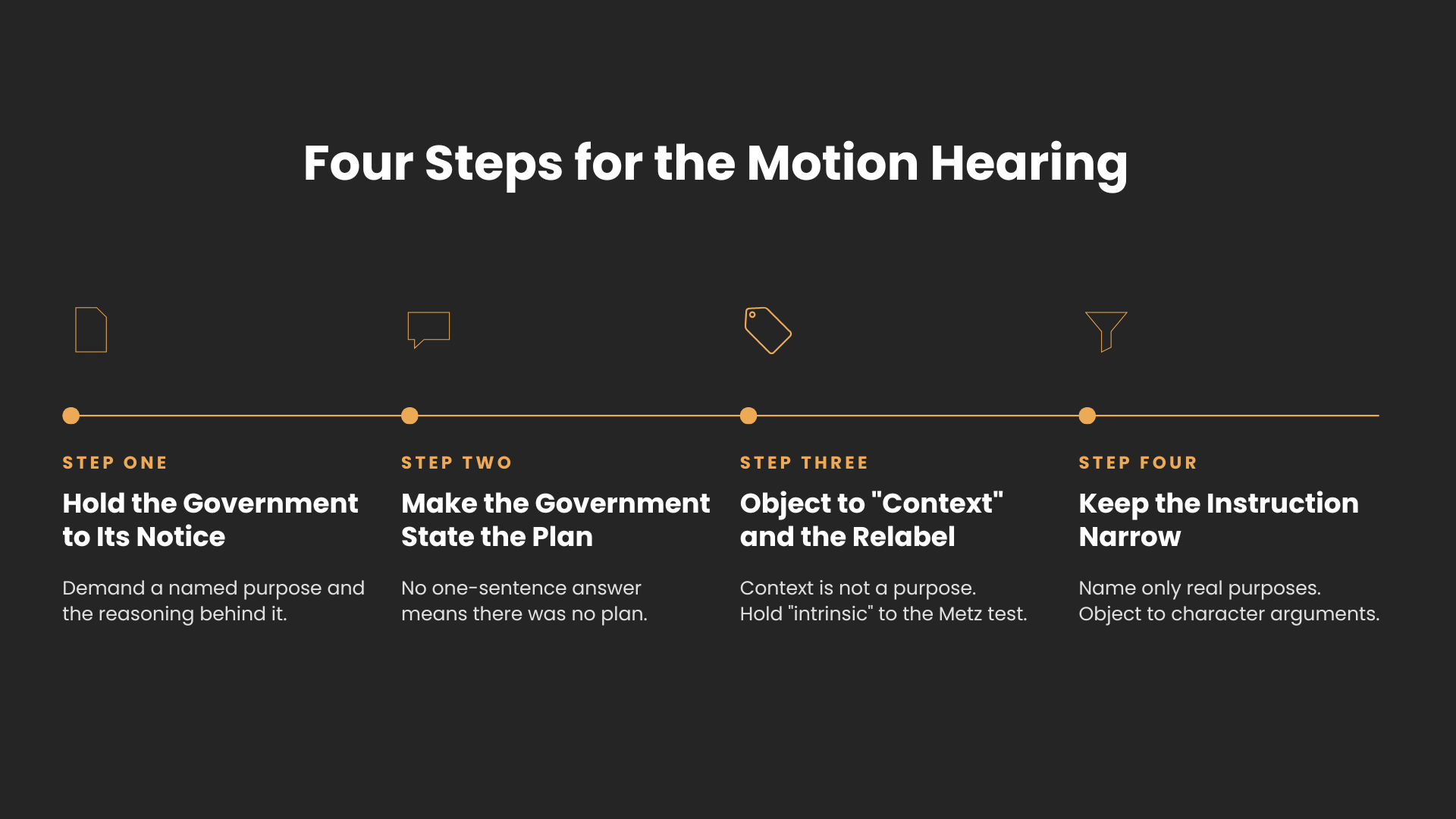
Step One: Hold the Government to Its Notice
The 2024 Manual requires trial counsel to “articulate in the notice the permitted purpose for which the trial counsel intends to offer the evidence and the reasoning that supports the purpose,” in writing before trial unless the court excuses it for good cause (Mil. R. Evid. 404(b)(3)(B)-(C), Manual for Courts-Martial, United States (2024 ed.), at III-19).
Menard was tried under the 2019 Manual (slip op. at 2 n.1), so do not argue that it applied this text – argue the text itself. A notice that lists “intent, knowledge, and common scheme” and gives no reasoning for any of them has not complied, and the motion should say so in the first paragraph.
Step Two: Make the Government State the Plan in One Sentence
Ask the question the CAAF judges asked at oral argument. What was the plan, and what final goal did the charged act serve as a stage of? If the answer is “to control her,” the answer is a description of the Accused’s character, and Menard and Becker say so.
If the Government pivots to motive, as it did in Menard, make it lay the Watkins foundation and then argue Morrison under M.R.E. 403.
Step Three: Object to “Context” and to the Relabel
Cite Menard, slip op. at 11, by page, and then get ahead of Young and res gestae: demand that the Government show the other acts are contemporaneous with the charged offense, or that some statement of the Accused is unintelligible without them. Dates matter, so put the timeline in the motion with a source for every date.
If the Government calls the evidence intrinsic to get out from under the notice rule, hold it to the Metz nexus, close in time, place, and circumstance. If it cannot meet that test, argue that what remains is M.R.E. 404(b) evidence offered without the notice and reasoning the rule requires.
Step Four: Keep the Instruction Narrow and Build the Prejudice Record
If the evidence comes in, insist that the instruction name only the purposes the military judge actually found and the evidence actually serves. Menard’s single-purpose instruction is the reason the motive argument died on appeal.
Then object every time trial counsel argues the acts as character, and make the record show how often the evidence was used, in opening, in testimony, in closing, and in rebuttal. Harmlessness is decided on that record, and appellate courts measure it literally.
In Greene-Watson, the Court noted that trial counsel made “only a brief reference” to the M.R.E. 404(b) evidence in closing (85 M.J. at 348 n.5). In United States v. Menard, the AFCCA counted 14 lines out of 296. Both cases ended the same way. Every “That’s control” belongs in an objection, so the record shows what the Government did with the evidence and not just how long it took to do it.
Then watch sentencing, because the history comes back. RH’s unsworn statement in Menard described “jealous accusations, overwhelming insecurity, constant invasion of privacy and emotional and mental abuse,” and the military judge let it stand as part of a continuous course of conduct.
The AFCCA, applying CAAF’s later decision in United States v. Campos, 85 M.J. 310 (C.A.A.F. 2025), found plain error and then found it harmless in a judge-alone sentencing (Menard, 2025 CCA LEXIS 137, at *39-40, *44-50). Object at the time, and cite Campos.
What Menard Means for M.R.E. 404(b)
The rule after Menard is clean:
- Uncharged acts need a named purpose that does real work.
- The instruction defines that purpose.
- And “context” is not one.
My view is simple: if the Government cannot say in one sentence what the plan was, there was no plan, and the members heard character evidence.
The result is sobering, because defense counsel can win this motion on appeal and still watch the client walk out with a punitive discharge, because harmlessness is measured against everything else the Government had. Win the motion at trial, where it counts – and if you lose it, spend the rest of the trial proving that the error mattered.
If you are facing a court-martial in which the Government has noticed your relationship history as a “plan,” call us before the motions deadline, not after it.
FAQs About M.R.E. 404(b) After Menard
What Did United States v. Menard Hold About Common Plan or Scheme Evidence?
The CAAF majority held that the military judge erred by admitting the password, phone, and blocking evidence as a common plan or scheme. None of those acts involved secretly viewing RH or otherwise invading her expectation of privacy, so they proved no plan to monitor her (slip op. at 11). The Court still affirmed the conviction.
Is Context a Permitted Purpose Under M.R.E. 404(b)?
No. Menard holds that context is not an approved non-propensity reason for admitting uncharged acts under M.R.E. 404(b)(2) (slip op. at 11). Genuine intrinsic or res gestae evidence remains a separate fight.
Can Trial Counsel Offer the Same Relationship Evidence as Motive?
Possibly. Menard left that question open (slip op. at 10 n.5). The Government must show that the prior acts express a motive that still existed when the charged act occurred, and the military judge must instruct the members on that purpose.
Can Prosecutors Call the Evidence Intrinsic Instead?
They can try, but the label does not control. The Government must show that the evidence is part of the charged transaction or meets the close nexus in time, place, and circumstance required by the res gestae cases.
Why Was the Conviction in Menard Affirmed?
The error did not substantially influence the findings. The Accused admitted placing the camera and checking its live feed, and his own texts tracked what RH was doing in real time. The uncharged acts were not needed to prove the viewing.
What Should I Ask a Court-Martial Lawyer Before the Motions Deadline?
Ask whether the Government’s notice identifies each act, states a lawful purpose, and explains how the act proves a disputed fact. Ask what motion counsel will file, whether “plan,” motive, or intrinsic evidence is the likely theory, and what limiting instruction counsel will request. Do not wait until the members have heard the relationship history.
Photo Source:
Capt. Christopher Pirog, 8th Fighter Wing deputy staff judge advocate, acting as defense counsel, delivers a closing argument during a mock court-martial exercise at Kunsan Air Base, Republic of Korea, September 10, 2021. (U.S. Air Force photo by Staff Sgt. Steven M. Adkins / DVIDS)