

I could not swallow water.
That is the sentence I kept coming back to in the second week of September, lying on the ear, nose, and throat ward at the Helios Dr. Horst Schmidt Kliniken in Wiesbaden with an intravenous line in my arm and three reprimand suspenses running on clocks from Texas to Hawaii to Korea. I have prosecuted cases in Iraq and Afghanistan, defended Soldiers in courtrooms from Texas to Bavaria and beyond, and spent 35 years believing I could work through almost anything if I wanted it badly enough. I could not work through this. For four days I could not drink a glass of water, and for most of a week I could not say a full sentence without pain.
I am writing about it because I live in the light. I wrote publicly about my drinking when it would have been easier to keep quiet, and I am writing about this for the same reason.
Somebody reading this is a lawyer who has not had a physical in four years, who answers email at the dinner table, and who has told the people at home “after this case” so many times that they have stopped asking. I was that lawyer. Part of me still is.
This post has two arguments, and they are not the same size. The smaller one is addressed to my colleagues on the government side of adverse administrative actions, and it concerns what they owe a Soldier when defense counsel lands in a hospital bed. The larger one is addressed to every lawyer who reads it, on either side, and it concerns what we owe ourselves and the people who love us before the clock runs out.
How a Sore Throat Became a Week in the Hospital
The timing would be funny if it had happened to someone else.
On 25 August I had surgery to correct my upper eyelids, which had sagged far enough to block the top quarter of my field of vision, and it went clean.
I came off limited duty on Tuesday, 8 September, and that same day my throat hurt badly enough that I could not work through it or eat a normal meal, and my doctor sent me home with a numbing spray.
By Wednesday the spray had stopped doing anything, which, I learned later, is its own warning sign – a topical anesthetic quits working when the problem is deeper than the surface. By that evening, I had essentially stopped eating and drinking.
On Thursday, 10 September, I could not work at all. We got a same-day appointment with a private ear, nose, and throat specialist in Wiesbaden, and because talking hurt too much, my wife, Ebru, texted him my symptoms, and he sent us straight to the hospital. The admission record logs me in at 13:02 as Notfall, the German word for emergency.
The final diagnosis was acute herpangina with bacterial superinfection. Herpangina is a viral illness most often seen in small children, and in a 61-year-old man it opened the door for bacteria to move into the ulcerated tissue it left behind.
My treating physician told me the infection involved my throat, my tonsils, my tongue, my vocal cords, and my larynx, called the case rare, and told me I was very unlucky. I spent eight days as an inpatient on:
-
intravenous antibiotics
-
intravenous pain medication that included low-dose morphine
-
an antifungal
-
steroids
-
fluids
I was released at midday on Thursday, 17 September, with a written order from three physicians for two weeks of physical rest and voice rest.
Documenting Symptoms and Working From a Hospital Bed
Here is the part I hesitated over, and then decided to tell anyway.
Between Wednesday night and Sunday afternoon I took in less than 200 milliliters of fluid. That is roughly a coffee cup, spread across four days, against the two liters a day a grown man needs.
I do not speak German, and I was not confident the night staff believed me when I said it hurt too much to drink. So, I did what 35 years of trial work trained me to do, and I built a record. From Saturday night through Sunday afternoon, I photographed every trip to the bathroom, seven images in all, each one carrying a timestamp and the hospital’s geolocation in its metadata, and the series shows the dehydration and then shows it correcting as the fluids caught up.
I am not proud of how fast a lawyer’s mind turns a hospital toilet into an evidence locker. I am a little proud that it worked.
On Sunday, 13 September, I swallowed for the first time in four days. I ate a bit. I drank even less. I talked, and the voice that came out was not mine – hoarse, thin, a register lower than the man who argues to boards and panels for a living. That scared me more than the IV did. A trial lawyer without a voice is a carpenter without hands.
Now the confession, and it is the reason this post exists. What was I doing between doses? I was working.
On admission day, from my hospital bed, I forwarded a client’s extension history to my co-counsel. I asked him to tell the client what was going on.
I texted my adult children that I was in the hospital, that Ebru, my wife, knew everything, and that I would answer their messages “between doses.” Then I spent some of those windows on extension requests, and on researching my own ethical obligations to a client while I was on intravenous pain medication.
When There Is No Judge to Grant the Delay
My docket that week held:
- three General Officer Memorandum of Reprimand (GOMOR) rebuttals
- two administrative boards
- a contested court-martial with a motion response due
- the planning for a defense conference in Izmir
How each of those deadlines behaved tells you most of what you need to know about where the protection sits in our system and where it does not.
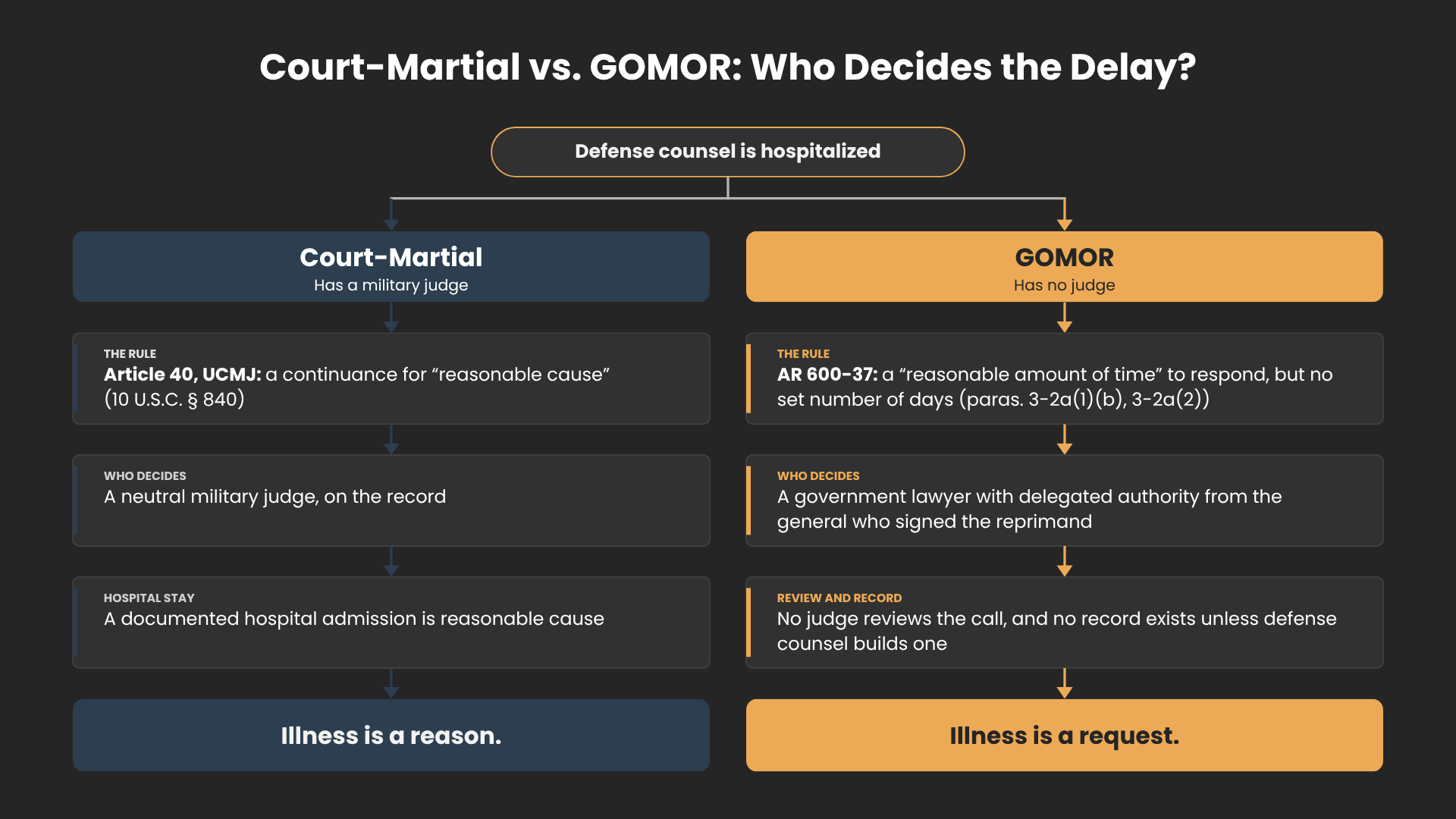
Court-Martial Continuances Under Article 40, UCMJ
In the court-martial, the response deadline moved to the following Monday. Nobody had to be persuaded to feel sorry for me.
A court-martial has a military judge, and Congress told that judge what to do with a lawyer who cannot work. Article 40 of the Uniform Code of Military Justice provides that the military judge “may, for reasonable cause, grant a continuance to any party for such time, and as often, as may appear to be just” (10 U.S.C. § 840). An emergency admission documented on hospital letterhead is reasonable cause by any measure I know, and a neutral officer with a robe and a record decides it.
GOMOR Rebuttal Time Under AR 600-37
A GOMOR has no judge. Army Regulation 600-37 conditions the permanent filing of unfavorable information on the Soldier having had “[a] reasonable amount of time to make a written statement in response,” and it says the time exists so the Soldier can make a “meaningful rebuttal” (AR 600-37, paras. 3-2a(1)(b), 3-2a(2)).
The regulation fixes no number of days, which leaves the obvious question of who decides what is reasonable. In practice, it is often a government lawyer holding delegated authority from the general officer who signed the reprimand – a lawyer in the same legal chain that will advise that general on whether to file the reprimand in the Soldier’s permanent record.
No judge reviews the call while it still matters, and no record of it exists unless defense counsel builds one. And the cost of saying no falls entirely on a Soldier who did nothing to make his lawyer sick.
That is the mechanism, and it explains everything that followed. Where a neutral decides, illness is a reason. Where an adversary decides, illness is a request.
How Three GOMOR Extension Requests Were Decided
Request One
Denied Immediately
Request Two
Silence, Then Approved
Request Three
Approved Immediately
Request One: Denied in 22 Minutes
On admission day my co-counsel asked for an extension in one of those GOMOR matters on my behalf, and the command granted one, to 17 September.
On 16 September, still an inpatient and still on intravenous therapy, I sent a signed memorandum asking for four more days, to Monday the 21st, setting out the particulars of the admission. The government lawyer opened it about eight minutes after it arrived, and about 14 minutes after that, he answered. He was sorry to hear about my medical matters; he hoped I would recover quickly, and the date stood.
22 minutes from send to no.
The reply gave no reason, and it did not say what four days, including a weekend, would cost the government, because the honest answer was nothing. The reprimand had been served, and four days would not have changed the Soldier’s status or the command’s control of the action by an inch.
I want to be fair to him, because fairness is the whole point of this post. He was courteous, and the division’s chief of military justice confirmed the next morning in writing that he had delegated authority to grant or deny GOMOR extensions.
He did nothing the regulation forbids, and that is my complaint, and it is a complaint about the system before it is a complaint about him: the regulation let him do it in 22 minutes, and nobody will ever review whether those 22 minutes were “reasonable.”
I was released at midday on the 17th, and the rebuttal went out the next morning. I will leave it to you to picture what that first evening home looked like, on pain medication, under a written order from three physicians to rest.
Request Two: No Response for Five Days, Then Approved
In a second matter, the request met silence: I sent it from the hospital on the 16th and heard nothing for five days, so on the day the suspense fell I sent it again with the German discharge summary and an English translation enclosed, asked for seven days, and promised in writing there would be no further request on any ground.
I should not have had to ask twice in the middle of my recovery for a week the Soldier was entitled to under the regulation’s own word, “reasonable.”
When it came, the answer was the right one. The chief of military justice in that command told me her office could not get my request in front of the two-star general before the suspense. So, she approved the delay herself, informally, and explained that her office could not have packaged the action for the general before my requested date anyway.
She said she would cover it, and the two-star general approved it. Seven days cost that command nothing, and she said as much.
Request Three: Approved Immediately
The third matter moved fastest of all. The request went quickly to a three-star general, the brigade judge advocate supported it, and the general approved it immediately. Like the request that drew a no in 22 minutes, it was my second request for delay in that case.
Same Medicine, Same Law, Different Decision-Maker
So, count them. Three reprimands, one hospital admission, and two of the three were second requests.
The two that reached a general officer came back approved, from people who showed humanity and an understanding of what the Soldier’s rights require. The one that stopped at a desk with delegated authority, a Major brigade judge advocate, came back denied in 22 minutes.
The medicine was the same, and so was the law. What changed was who decided, and a Soldier’s right to a meaningful rebuttal should not depend on which desk his lawyer’s email lands on.
What a Denied GOMOR Extension Costs the Soldier
Think about what a refusal actually leaves on the table.
-
The Soldier gets a rebuttal written by a lawyer on morphine.
-
Or he gets a substitute lawyer who has never read the investigation, never spoken to his witnesses, and is meeting him for the first time a few days before the suspense.
-
Or he gets a thin filing with a promise to supplement, which a busy general officer may or may not read.
Every one of those options is worse for him, and a GOMOR filed in the Official Military Personnel File follows a career into every promotion board, every selection board, and often into a separation or retirement grade determination.
The government saves four days. The Soldier pays for 20 years. And the lawyer pays with his health—which is where this post is really going.
Why Commands Are Skeptical of Medical Extension Requests
I have sat on the government’s side of this as a trial counsel, a special victim prosecutor, and a brigade judge advocate, and I know exactly what a second extension request on the eve of a suspense usually looks like. Commands are right to be skeptical, because deadlines matter, discipline that drags loses its meaning, and I have watched defense counsel use a vague “medical issue” as a tactic. The objection gets sharper in my case, because my firm has 16 lawyers.
Why could someone else not have written the rebuttal?
I concede all of that, and I concede the last point most of all. A firm should have coverage, and mine did act: my co-counsel made the first request on the day I was admitted and told the client within minutes.
But a GOMOR rebuttal is a reading task before it is a writing task. The lawyer who has read the investigation, interviewed the witnesses, and earned the client’s trust is the one who carries it, and swapping him out a few days before the suspense is not the same representation with a different name on the signature block.
What the objection does not reach is the request before the government lawyer. Skepticism is answered by documentation, not by a stopwatch. When a request arrives with hospital records, asks for days rather than weeks, and costs the command nothing it has not already secured, skepticism is satisfied.
Two of the three commands I dealt with in September reached exactly that conclusion, and in one of them the brigade judge advocate, sitting in a chair I once held, backed the request. Saying no at that point protects no interest the government actually holds. It only moves the cost onto the Soldier and onto his lawyer’s body.
Why Lawyers Cannot Keep Putting Their Health Last
Now the larger argument, the one I care about more.
My Own Health and Sobriety
Every one of us has an expiration date, and none of us knows it. I am 61 years old, and my hospital chart records that I smoke 10 cigarillos a day, which is a risk factor for exactly the kind of throat and airway trouble I just survived, and that is nobody’s fault but mine.
One week from today, on 14 October, I will be five years sober. And I have already stood once at an expiration date that nearly came early. In May 2019, in Germany, I hit the bottom of years of drinking and depression, and I have written before about the thoughts that came with it.
Help arrived because my family intervened. Neither the Army nor my law practice saved my life that day – the people who love me did.
Who Held Everything Together in September
I tell you that, so you understand what I mean when I say the work never thanks you for the years you give it. I have given it plenty, and I have failed marriages behind me, three children, and two stepsons, and I know what absence costs because I have paid it, and I am still paying it down through the slow work of showing up.
In September, the people who held everything together were not clients. Ebru texted my symptoms to the specialist when I could not speak, called the ward, translated for me, and kept the firm informed. My children got a text so they wouldn’t be frightened by the silence. My co-counsel called the client.
Everyone who mattered was taken care of by someone else, because I could not take care of anyone, including myself.
Why “I Will Rest After This Case” Never Works
We tell ourselves a specific lie in this profession, and I have told it more than most: “I will rest after this case.” There is always another case.
The Soldier with the reprimand is real, the board is real, the deadline is real, and so is the clot, the heart attack, the infection you ignored for three days because you had a filing due. A lawyer who works himself into a hospital bed has not served his client – he has abandoned him on a delay.
And a lawyer who misses a child’s graduation for a GOMOR rebuttal that could have been written a week earlier has made a trade he will spend years regretting.
Lawyer Drinking, Depression, and Anxiety Statistics
The numbers say I am not alone. In the largest study of its kind, covering 12,825 licensed, employed American attorneys, 20.6% screened positive for hazardous, harmful, or potentially alcohol-dependent drinking, and 28%, 19%, and 23% reported symptoms of depression, anxiety, and stress (Krill, Johnson & Albert, Journal of Addiction Medicine, 2016).
For years I was in that 20.6% and told myself I was in control. I was NOT in control – I was undiagnosed.
20.6%
Drinking
28%
Depression
19%
Anxiety
23%
Stress
Neglecting Your Health and the Lawyer’s Duty of Diligence
Neglecting yourself is NOT noble. It is a disservice to the client who needs you alive, to the family that needs you present, and to the colleague on the other side who will have to deal with whoever shows up in your place.
Our own ethics rules recognize as much. The official comment to the American Bar Association’s diligence rule says that, to prevent neglect of client matters if a sole practitioner dies or becomes disabled, the duty of diligence may require a plan that “designates another competent lawyer to review client files, notify each client of the lawyer’s death or disability, and determine whether there is a need for immediate protective action” (ABA Model Rule 1.3, cmt. 5).
The profession already admits we are mortal, and most of us just have not done the paperwork.
What I Am Asking My Colleagues, and What I Am Doing
Four Questions to Ask Before Denying an Extension Request
To my colleagues who decide extension requests in GOMORs, Article 15 appeals, administrative separations, investigation rebuttals, and every other action without a judge in the room, run four questions before you answer:
Question One:
Is the incapacity documented, or at least promised in writing with documents to follow?
Question Two:
Is the request short and specific – a date, not an open-ended delay?
Question Three:
What does the government actually lose in the time asked? Is the reprimand served, the flag in place, any witness or record at risk?
Question Four:
What does the Soldier lose if you refuse?
If the answers are documented, short, nothing, and a great deal, grant it. If you still intend to say no, put your reason in writing and send it to the general officer who will make the filing determination, because the decision belongs to that general, and the Soldier’s “reasonable amount of time” belongs in front of the person who signs.
My third command did exactly that, and a three-star general found the time to say yes. And use the rule I would apply if I were back in that chair: grant the defense lawyer the time you would want granted to you from a hospital bed.
What I Am Changing in My Own Practice
To every lawyer reading this, on either side, here is what I am doing, and I invite you to copy it.
I am putting the incapacity plan in writing. Every matter in my office will have a second lawyer named on it, with access to the file and a script for telling the client what is happening, so that the next time I am flat on my back, nobody has to improvise.
I am scheduling recovery the way I schedule a hearing. I now build two travel days and a recovery day on each side of every in-person session, and on Friday I fly to Izmir under that rule. It felt self-indulgent to write it into the calendar, but it isn’t, because it is the difference between arriving as an advocate and arriving as a patient.
I am keeping a medical date the way I keep a suspense. My voice is coming back, but if it is not substantially normal by 12 October, I will have a laryngoscopy in Frankfurt, no matter how good I otherwise feel. And yes, the cigarillos. I know.
I am telling my people. Ebru knew everything about my condition and my calendar, which is why the week did not turn into chaos. If you don’t have someone who knows everything, get one.
And I am putting my family on the calendar in ink. A birthday dinner is as immovable as an Article 39(a) session. A call with my children is not something that happens if the brief is done. It happens, and the brief waits.
If what you are carrying is heavier than a sore throat, the Texas Lawyers’ Assistance Program offers confidential help to lawyers, law students, and judges at 1-800-343-8527 (TLAP). If you are a veteran or a service member, or you love one, the Veterans Crisis Line is free and confidential: dial 988 and press 1 in the United States, or call +1 844-702-5495 from Europe (Veterans Crisis Line).
With Gratitude
I am grateful to the doctors and nurses at Helios HSK, who treated a hoarse American who could not speak their language with patience and skill. I am grateful to my co-counsel and staff, who covered for me without being asked twice. I am grateful to the chief of military justice who said she would cover it, to the brigade judge advocate who backed my request, and to the two general officers who approved the delays, because they remembered whose rights the time protects. I am grateful to my children for their texts, and most of all to Ebru, who spoke for me when I could not.
I do not know my expiration date. Neither do you.
I would rather spend the time I have left as a lawyer who is healthy enough to fight, sober enough to see, and home often enough to be missed for the right reasons. The Soldiers we represent deserve that lawyer. So do the people waiting for us at the end of the day.
With gratitude, and a voice that is coming back,
Will