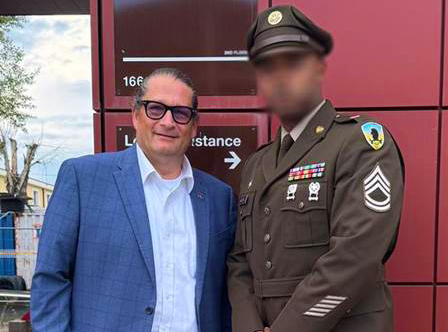
On August 22, 2025, the Warrior Law Team successfully defended a Senior NCO, SFC Ivan Grissom, at a 2-day domestic violence separation board. Despite government efforts to separate him from the Army for alleged domestic violence and characterize his service as Other Than Honorable, the separation board for domestic violence ruled that while one act of violence occurred, it did not warrant separation. SFC Grissom was retained in the U.S. Army, preserving his 15-year career, retirement, and benefits.
FAQs
Q: What was the outcome of the Senior NCO’s domestic violence separation board?
A: The Board found one act of misconduct but ruled it did not warrant separation. The Senior NCO was retained in the Army, protecting his career and benefits.
Q: Can a Soldier be retained after allegations of domestic violence?
A: Yes. If the government cannot prove misconduct by a preponderance of evidence or if the conduct does not justify separation, a Soldier may be retained.
Q: How did the Warrior Law Team help the Senior NCO?
A: The Warrior Law Team exposed unreliable witnesses, highlighted investigative failures, and presented strong defense evidence, leading to the Senior NCO’s retention.
The Accusations and Government Request
Accused of two specific incidents of violence against his wife resulting from a pattern of abuse, SFC Ivan Grissom faced a domestic violence separation board where the government was seeking to separate him for serious misconduct (AR 635-200, paragraph 14-12(c)) and characterize his service as Other Than Honorable (OTH). The European-based Soldier turned to the Warrior Law Team after the CID investigation and following his receipt of a permanent GOMOR.
The Government Case
At the separation board for domestic violence, the government presented the CID Report of Investigation (ROI) and the video statements of the alleged victim, Ms. Jaylene Grissom, her 18-year-old daughter, Ms. Melanie Geotz, and Air Force Staff Sergeant Miriam Fairchild. Additionally, the government presented the telephonic testimony of SFC Grissom’s commander, CPT Brock Adkisson, first sergeant, 1SG Mason Aoshima, and SSgt Fairchild.
The Video Statements
Ms. Jaylene Green’s Video: In the 2 hour long video statement of the alleged victim, taken two months after the incident, after she met with a victim advocate and her Special Victim Counsel, she alleged that SFC Grissom got mad at her while playing a video game with friends when she told him that she was going out with SSgt Fairchild and attacked her, strangled her to the point where she could not breath, and held a sharp folding hunting knife to her throat, saying “you don’t think I will kill you?” She said that she had only escaped by grabbing his cellphone off an end table near the door and throwing it out of the apartment. When he went to retrieve it, she locked him out of the apartment. She testified that she sustained a cut on her arm from the knife while protecting herself from SFC Grissom. In the CID investigation, there were photographs of a healed scar on her arm taken after the interview, a selfie showing a red mark on the lower part of her neck allegedly taken that night, and a screenshot of photos of herself from 5 months prior showing dark circles under her eyes, where she claimed SFC Grissom punched her in the face.
Miss Melanie Geotz’s Video: The government then presented a 20-minute video statement from Ms. Grissom’s daughter, Melanie, taken the following day, in which she repeated the narrative provided by her mother. She stated that she heard an argument in the living room and went to see what was going on. That’s when she saw her mother and SFC Grissom arguing, and witnessed him push her against the door with his left forearm across her throat, and grab a folding knife with a black handle from the table and hold it to her throat with his right hand and say, “you don’t think I will kill you?” before running back to her room and waiting until the fight ended before helping her mother. They both stated that Ms. Grissom dressed the wound with gauze, and they stayed in the apartment for the next couple of days.
SSgt Miriam Fairchild’s Video: The government also presented a 30-minute video of SSgt Fairchild. In the video, SSgt Fairchild stated that she became friends with Jaylene about a year prior, meeting her often at the base bar and later socializing regularly in the bar and club scene. She described Jaylene as outgoing, assertive, and honest, though more reserved when her husband was present (the one time she met SFC Grissom).
SSgt Fairchild recalled a significant phone call in February 2024 when she twice tried to reach Jaylene before an evening out. On the second attempt, Jaylene answered briefly, saying she had just been “attacked” and would call back. SSgt Fairchild heard a male voice—recognized as Jaylene’s husband—in the background, although it was indistinct. Jaylene later told SSgt Fairchild by text that something had been thrown at her head, causing pain and bleeding, and that she locked her doors to keep him out.
SSgt Fairchild admitted her memory was imperfect and affected by ADHD. Still, she recalled panic at hearing Jaylene’s words, contacting SrA Walton O’Malley, a military police friend, and providing a statement to the Security Forces. She kept texts from that night and provided screenshots to the Security Forces. Overall, she described Jaylene as reluctant to share abuse details but clearly distressed and fearful during and after the phone call.
Facing a Separation Board? Schedule an Appointment

Government Witness at the Separation Board for Domestic Violence
SSG Miriam Fairchild: SSgt Fairchild also testified via telephone at the domestic violence separation board that she called Jaylene on Facebook to check when she was going to pick her up to go out, and she heard her screaming. Jaylene told her, “He hit me, he hit me, stay over there,” and then the phone hung up, and she could not reach her again. She said she was testifying at the board because she wanted to prevent domestic violence, as she herself had been a victim of domestic violence.
In the CID packet were screenshots of texts after the incident between Jaylene and SSgt Fairchild, generally noting that Jaylene did not want to go forward or call the military law enforcement, saying that SFC Grissom choked her, and that she cut her arm when SFC Grissom threw his headset. There was nothing in the texts about a knife, threats, head injuries, or her daughter, Melanie, witnessing the incident.
Also in the CID packet were a series of text messages purportedly from SFC Grissom to Jaylene, in which he was angry and told her to “go kill herself,” predating the alleged assaults.
CPT Brock Adkisson: CPT Adkisson testified telephonically that he had been SFC Grissom’s company commander for the past ten months and described SFC Grissom as a resilient and professional soldier. Despite personal difficulties and ongoing allegations, SFC Grissom continued to perform his assigned duties effectively and maintained a professional attitude. CPT Adkisson noted that he never had any issues with SFC Grissom’s work performance and that his interactions with other soldiers were appropriate, though limited due to the small number of personnel at the duty station. Located in a different country, he sees SFC Grissom quarterly and relies on his direct supervisors for day-to-day observation. CPT Adkisson acknowledged that the only negative impression he holds is based on the CID report and associated text messages, not his own firsthand experience. Based only on the CID ROI, he testified that SFC Grissom should be separated. While he has heard rumors about SFC Grissom’s wife’s infidelity, he has no personal knowledge of their relationship dynamics. Overall, CPT Adkisson affirmed SFC Grissom’s duty performance as solid and professional.
1SG Mason Aoshima: 1SG Aoshima testified that he has known SFC Grissom for approximately five months, having met him once in person and spoken with him several times by phone since then. He described SFC Grissom as a straightforward, reasonable, and focused individual who appeared genuine during their interactions. 1SG Aoshima emphasized that his personal dealings with SFC Grissom were limited, so he could not fairly judge his overall character or daily performance. While his impression of SFC Grissom personally was positive, 1SG Aoshima acknowledged that his concerns were mainly based on the CID report, photos, and witness statements, which suggested serious issues. He admitted he was not present for the events in question and had limited firsthand knowledge. Overall, 1SG Aoshima’s view of SFC Grissom was shaped by the contrast between his brief, professional interactions with him—where SFC Grissom seemed composed and focused—and the negative portrayal contained in the law enforcement investigation. Based on the CID ROI, 1SG Aoshima believed SFC Grissom should be separated.

Facing Loss of Benefits and Retirement? We Defend Your Future
The Defense Case
The defense called six witnesses and the Respondent, SFC Grissom, who testified under oath. The witnesses included 1) his former first sergeant, SFC Larissa Baldwin, 2) his former supervisor, SSG Tiffany Granger, 3) one of the individuals with whom he was on PlayStation the night of the incident, Mr. Brett Flores, 4) two individuals who knew Ms. Jaylene Grissom’s character, including her infidelities and drug use, Mr. Daniel Loudermilk and Mr. Briscoe Hamilton, and 5) his current supervisor for the past two years, MSG Joseph Furth.
SFC Larissa Baldwin: SFC Larissa Baldwin, who served as First Sergeant over SFC Grissom for 21 months, described him as a reliable and positive soldier. She noted that SFC Grissom performed both his assigned HR duties and, at times, the demanding role of Executive Officer, earning praise from both officers and enlisted. She never observed misconduct or unprofessional behavior from him, and peers regularly commended his performance. The incident involving his wife, Jaylene, came as a complete surprise to her. SFC Baldwin did not know Jaylene personally, aside from brief phone contact after the incident, during which Jaylene expressed concerns about her daughter remaining in school locally and mentioned seeking money through legal means. SFC Baldwin reported that SFC Grissom consistently denied laying hands on his wife and insisted Jaylene was the aggressor. While SFC Baldwin acknowledged learning of alleged abuse through the CID report, her direct experience was of SFC Grissom as a dependable, truthful, and professional Soldier.
SSG Tiffany Granger: SSG Tiffany Granger worked closely with SFC Grissom from January 2023 to April 2025, first as a peer and later as his supervisor. She described him as an exceptional Soldier whose dedication often required reminders to step back from work. He performed with unmatched commitment, took on additional responsibilities, and continued excelling even after the February 2024 incident involving his wife. SFC Grissom remained professional, never allowing personal issues to interfere with his duties, and served as a reliable and disciplined leader admired by his peers and subordinates. SSG Granger affirmed she would gladly serve with him again.
In contrast, she characterized Jaylene as dishonest and manipulative, noting her association with service members under drug investigation, a decline in appearance consistent with drug use, and a pattern of fabricating stories, including false claims about SSG Granger herself. She emphasized Jaylene’s lack of credibility versus SFC Grissom’s integrity, concluding that SFC Grissom is a proven asset to the Army.
Brett Flores: Mr. Brett Flores, a longtime friend of SFC Grissom, testified that on the night of the alleged incident, he was playing Call of Duty with SFC Grissom when Jaylene entered the room aggressively. Mr. Flores heard SFC Grissom repeatedly say, “Get away from me,” and “I’m trying to get out the door, can you move out of the way?” He also recalled SFC Grissom saying, “Don’t spit on me again,” and referencing Jaylene bringing out scissors, to which SFC Grissom asked, “So you got scissors, are you going to stab me?” Mr. Flores heard Jaylene yelling, cursing, and blocking SFC Grissom from leaving, as well as the sound of objects being thrown, including his PlayStation 5 controller. Notably, Mr. Flores stated he never heard Jaylene scream in pain, cry out as if hurt, or sound muffled. Instead, she kept yelling continuously. Mr. Flores confirmed that he reached out to SFC Grissom’s parents and coworkers that night and the next day when contact with SFC Grissom was lost. Days later, SFC Grissom talked to Mr. Flores, saying Jaylene had taken his keys, spit on him, blocked his exit, and later called the police.
Daniel Loudermilk: Mr. Daniel Loudermilk testified that he met Jaylene in September 2023 at a bar and saw her frequently, often daily, without her husband. He reported she regularly used drugs, including cocaine and meth, and personally introduced him to cocaine, which led to his own separation from the Army. Mr. Loudermilk stated that Jaylene often lied to people and manipulated situations. She was determined to remain in the host nation, openly discussing plans to marry a local national to stay, despite being married to SFC Grissom. He recalled her filling out paperwork to sponsor “Jon,” a drug supplier on base, for a better job, and she repeatedly said she would not return to the U.S. Despite hearing Jaylene mention marital issues, she never claimed that SFC Grissom hit her, held a knife to her neck, or physically abused her. He testified that he witnessed another man punch Jaylene in the face after she first hit him in the face. Mr. Loudermilk described SFC Grissom as respectful, supportive, and a positive influence during his separation process, in stark contrast to Jaylene’s destructive behavior.
Briscoe Hamilton: Briscoe Hamilton, a U.S. Air Force E-4, stated he knew both SFC Grissom and Jaylene, often seeing Jaylene at bars, clubs, and parties without her husband. He described Jaylene as erratic, emotional, manipulative, and addicted to drugs, specifically cocaine, which he personally witnessed her using. SrA Hamilton noted she would be loud, boisterous, and aggressive, especially while under the influence. He confirmed Jaylene frequently lied to people to get her way. She often expressed her desire to remain in the host nation, telling others she was looking for a local national man to marry to stay. SrA Hamilton emphasized that while he initially believed Jaylene’s claims against SFC Grissom, after meeting him, he found it hard to believe that SFC Grissom would assault her, describing him as respectful and not the type of person to commit such acts. Overall, SrA Hamilton’s observations painted Jaylene as unreliable and SFC Grissom as a good Soldier with a positive demeanor.
MSG Joseph Furth: MSG Joseph Furth, who supervised SFC Grissom for over a year, described him as a reliable, proactive, and positive Soldier who continued to perform at a high level despite significant personal stress. SFC Grissom not only fulfilled his role as HR NCO but also assumed XO-level responsibilities, managing logistics and property tasks usually assigned to a captain. MSG Furth noted SFC Grissom’s professionalism, good attitude, and ability to separate personal legal issues from his duty performance, which he greatly admired. He confirmed that SFC Grissom consistently denied any physical abuse of his wife. However, he admitted to verbal arguments and physically moving her to leave the home on the night in question. MSG Furth recommended SFC Grissom’s retention, stressing his proven value to the Army, but suggested a PCS to give him a fresh start away from personal baggage. He emphasized that SFC Grissom has already demonstrated the capacity to perform beyond his grade and would continue to be a strong asset in another unit.
SFC Ivan Grissom: SFC Grissom testified under oath and subject to cross-examination and questioning from the board that his relationship with Jaylene was toxic, marked by frequent conflict and infidelity on her part. Despite these issues, he stated he genuinely loved her, raised her children as his own, and hoped their assignment to Europe would give their marriage a fresh start. He admitted they often yelled at each other, but emphasized that Jaylene was consistently the physical aggressor. She regularly stayed out all night, became involved in drugs, and told him directly she would never return to the United States.
SFC Grissom noted that Jaylene’s allegations surfaced less than five days before his PCS back to the U.S., which would have forced her to return to the States. He denied ever striking her in the face. Regarding the night of the incident, he described Jaylene spitting in his face, coming at him with open scissors, refusing to give him his keys, and physically blocking his exit from the house. He admitted only to placing his arm across her chest, below the collarbone, to move her away from the door so he could leave the volatile situation. He also recounted prior incidents in which she threw objects at him, once causing a lip injury that required stitches.
Defense Documentary Evidence
The defense offered four exhibits: Exhibit A consisted of his most noteworthy awards, including a Defense Meritorious Service Medal, and his NCOERs as a Staff Sergeant and Sergeant First Class; Exhibit B consisted of seven character letters; Exhibit C consisted of a text message exchange with Jaylene that predates the incident where she states, “Fact is I’m not going to Kentucky, nor am I going to the states. I am fully prepared to duck down and stay my ass [here] with all consequences included;” and Exhibit D that outlined the federal statute and Army Regulation on Transitional Compensation documenting that Jaylene would receive approximately $2,400 a month in benefits from the Army if SFC Grissom were separated from the Army for violence against his family.
Command Recommends Separation? We Fight Back!

Summarized Government Arguments
The Government acknowledged the seriousness of the case and urged the board to take decisive action by separating SFC Grissom from the Army with a General (Under Honorable Conditions) characterization of service, acknowledging the overwhelming character and duty performance evidence. They framed the decision not merely as a legal judgment, but as a “hiring and firing” determination: whether the Army can continue to place trust in a Soldier accused of domestic violence.
The Government argued that allegations of domestic violence are fundamentally incompatible with the values and standards of military service, regardless of any misconduct or credibility issues attributed to Jaylene, including her alleged drug use or history of infidelity. What mattered, they insisted, was that the evidence before the board demonstrated behavior that disqualified SFC Grissom from further service.
They emphasized that the video-recorded testimony of Jaylene and Melanie was consistent and mutually reinforcing, and that SSG Fairchild’s testimony further corroborated their accounts. Together, these witnesses presented a clear and credible picture that could not be ignored.
Finally, the Government asserted that CID’s investigation provided sufficient evidence for the board to find that SFC Grissom engaged in conduct unworthy of retention. They stressed that in a “hiring and firing” context, the standard was not absolute certainty, but whether the Army could, in good conscience, continue to employ him as a leader and representative of its values.

Facing Loss of Benefits and Retirement? We Defend Your Future!
Summarized Defense Arguments
I argued that the government had not met its burden of proof in proving the offenses by the preponderance of the evidence. Their case rested on unreliable witnesses, an incomplete investigation, and speculation. If the government could not prove every allegation with credible, corroborated evidence, then the law requires the board to find that SFC Grissom should be retained.
- Burden of Proof and Presumption of Innocence
I reminded the separation board for domestic violence that SFC Grissom carries no burden to prove his innocence. He was presumed innocent, and that presumption remained unless the government proved by the preponderance of the evidence that he committed violence against Jaylene, and if he did, it did not justify separation. I noted that he did not have to testify or produce evidence—but he did, openly and candidly. The government, by contrast, failed to investigate exculpatory leads and presented unreliable, biased evidence.
- Credibility: SFC Grissom vs. Jaylene
I argued that credibility is the heart of this case. SFC Grissom testified under oath, answered every question, and admitted the unflattering truth—that he and Jaylene often yelled at each other. He denied ever striking her. That was honesty.
Jaylene, however, never faced cross-examination because she refused to testify at the board. Her stories shifted—from claiming an accident with a headset to later alleging a knife at her throat. I argued that she refused to testify before the separation board for domestic violence, and as a result, they were denied the opportunity to assess her credibility. Meanwhile, SFC Grissom stood before them and owned his faults.
- Motives to Fabricate
I argued that Jaylene had powerful incentives to lie. Transitional Compensation alone, up to $2,400 per month for three years, provided her with a financial incentive. She told others she had no intention of returning to the U.S. and needed a way to remain in the host nation. Accusing him of domestic violence achieved this goal, as SFC Grissom was flagged and prevented from PCSing until the final action in the case. These motives were undeniable.
Her daughter, too, had reasons to echo her mother’s story: the desire to stay in the local area, complete her education, and remain close to her custodial parent. Her testimony emerged months later, sounding remarkably like Jaylene’s, almost as if it had been read from a script, a strong indicator of coaching or contamination, especially since it only surfaced after Jaylene’s Transitional Compensation briefing.
- Failures of CID’s Investigation
I reasoned that the government’s own investigators failed the separation board for domestic violence. No medical exam was conducted on either party. No forensic testing was performed on the alleged weapon (which was never found), headset, or clothes. No digital forensics were done on the phones of Jaylene, SFC Grissom, or SSgt Fairchild to contextualize the relationship or isolated text messages. Friends who were gaming live with SFC Grissom were never interviewed. Jaylene’s known associates and drug involvement were not investigated, even though there was a comprehensive Air Force OSI Investigation resulting in the identification of Jaylene as a central figure. Even SFC Grissom’s supervisors, who knew his character, were overlooked. CID presented a patchwork case, driven by confirmation bias, rather than conducting a thorough investigation to uncover the truth.
- Weakness of SSgt Fairchild’s Testimony
I critically addressed SSgt Fairchild’s testimony. She admitted to frequent panic attacks, ADHD, and crying through the interview. She only heard part of a 30-second phone call and relied heavily on what Jaylene told her later via text. She couldn’t even make out what SFC Grissom said in the background. Her memory was clouded by stress and months of delay. Her testimony was more emotion than fact, colored by her history as a victim of domestic violence, looking to make a difference for those who were victims.
- Lawful Use of Force and Self-Defense
I argued that even if the separation board for domestic violence believed that SFC Grissom placed his arm across Jaylene’s chest (which he admitted), the law allows him to use reasonable force to escape restraint. On that night, Jaylene spat in his face, threatened him with open scissors, stole his keys, and blocked the door. I argued that moving her aside so he could leave was not violence—it was self-defense and an effort to disengage.
- Separation Is Not a “Hiring/Firing” Decision
Finally, I stressed that the government mischaracterized this board as a simple hiring decision. It was not. Separation would strip SFC Grissom of everything he has earned over 15 years: his pension, Tricare, GI Bill, commissary privileges, VA benefits, and even his professional identity, noting the lifetime price tag was over $2,000,000 of lost benefits. I argued that this was not Microsoft or Amazon, where you can find another job. This was a life’s work, erased in an instant.
This blog post is for informational purposes only and does not constitute legal advice. Service members facing EO, discrimination, unequal treatment, or other legal challenges should consult qualified legal counsel.
Military Family DV Support – Get Help During DVAM 2025
Conclusion
I argued that the government’s case collapsed under its own weight. Jaylene was not credible. Her daughter was compromised. SSgt Fairchild misperceived and misremembered. CID failed in its duty. By contrast, SFC Grissom testified openly, admitted arguments, and consistently denied abuse. His record of service showed dedication, leadership, and integrity.
I submitted that the government had not met its burden. The presumption of innocence stood, and justice required one outcome: the retention of SFC Grissom in the Army.
The Board Results
After 1 hour and 45 minutes, the separation board for domestic violence found that SFC Grissom committed a single act of violence towards his wife, Jaylene, but the misconduct did not warrant separation. SFC Grissom broke down in tears, relieved that someone finally listened to his story and understood the situation.
This case highlights the importance of a strong defense in a domestic violence separation board to protect a service member’s career.
This blog post is for informational purposes only and does not constitute legal advice. Service members facing EO, discrimination, unequal treatment, or other legal challenges should consult qualified legal counsel.